
One of the most frustrating parts of recovering from a narcissist relationship is when the narcissist stays on your mind long after they’re gone. This happens to a lot of people!
You tell yourself you’re done with them. You know they treated you badly. Yet somehow, they’re still here. In your thoughts, your dreams, and your imagination.
You may replay old arguments. Wonder why they did what they did. Wonder what they’re doing now. So you check their social media, even though you know it hurts.
If this sounds familiar, you’re not alone. It’s a common response to narcissistic abuse, and there’s clear psychological reasons why this happens.
The good news is that you can stop thinking about a narcissist. It won’t happen overnight. But with the right approach, their grip on your mind fades over time…
Please Watch The Following Short Video to Aid Your Understanding…
Why You Can’t Stop Thinking About Narcissists
Many survivors believe they think about the narcissist because they’re still in love. But this is rarely the case.
Narcissist relationships create powerful emotional conditioning. Your brain gets trapped in cycles of uncertainty, hope, disappointment, and anxiety.
Your mind naturally tries to make sense of unresolved situations. So it keeps looping around, looking for answers.
Unlike healthy relationships, narcissist relationships rarely provide closure. Instead, they leave unanswered questions…
- Why did they suddenly change?
- Did they ever love me?
- Was I good enough?
- How could they move on so quickly?
Understand That You’re Breaking A Trauma Bond
One of the biggest reasons you can’t stop thinking about a narcissist is because of trauma bonds.
The relationship alternated between affection and cruelty. One day they made you feel special. The next you were criticised, ignored, and rejected.
This unpredictable pattern creates an emotional addiction similar to gambling. Your brain keeps hoping that the next emotional “reward” is around the corner. So even after the relationship ends, your mind keeps searching for that reward.
Recognising this removes a lot of self blame. You’re not missing them. You’re experiencing withdrawal from the emotional conditioning they created.
Please CLICK HERE For How To Break Trauma Bonds With Narcissists
Stop Trying To Understand Narcissists
Many survivors spend months, even years, trying to understand why the narcissist behaved like they did. You may watch videos, read articles, and analyse every conversation.
Learning about narcissism is incredibly helpful in the early stages of recovery. However, there comes a point when researching becomes another way of staying emotionally connected. Ask yourself…
Am I learning to heal. Or am I secretly hoping I’ll finally understand them?
You may never get all the answers you’re looking for. Healing often begins when you accept that some questions don’t have satisfying answers.
Accept That Closure Comes From You
One of the hardest truths to accept is that narcissists rarely provide genuine closure. Instead they may…
- Deny what happened.
- Blame you.
- Rewrite history.
- Pretend the relationship never mattered.
- Move on immediately.
Waiting for them to explain themselves keeps you emotionally trapped. Because you’re relying on them to give you something. And you should know by now narcissists aren’t reliable!
Not only this, but if the narcissist senses you want closure, then they have a weapon to use against you. They can entice you to meet up for closure. Then use this time to manipulate, hurt, or reel you back in.
Instead of waiting for them for closure, create your own. Learn enough about narcissism where you understand why the narcissist did most of the things they did. Because this reveals far more than they will ever admit.

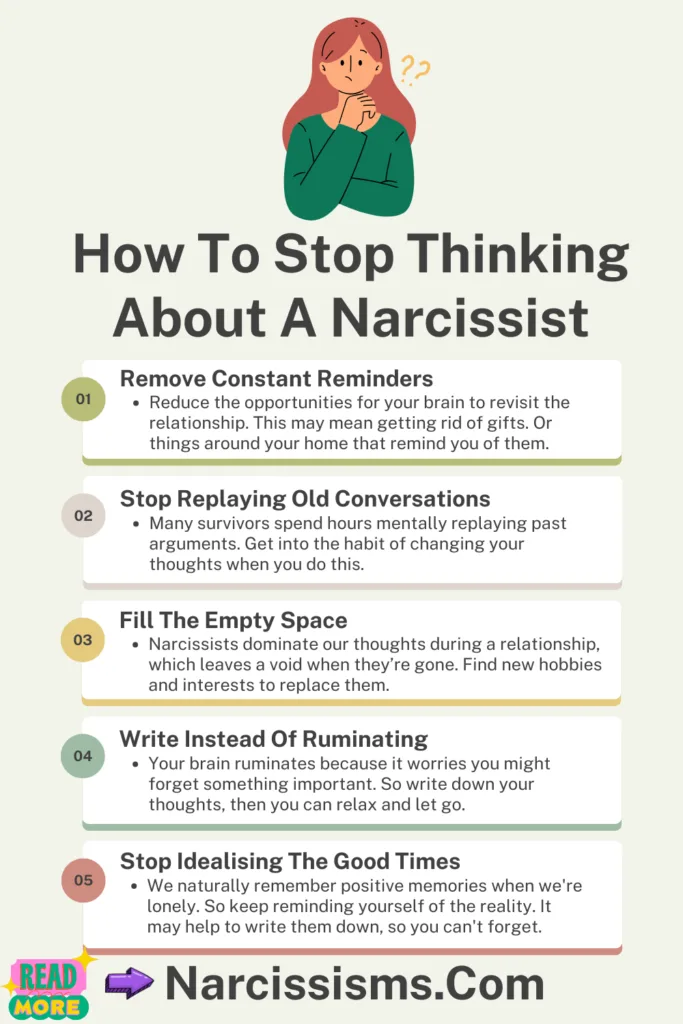
Remove Constant Reminders
Your brain struggles to let go when it’s constantly reminded about the narcissist. Look honestly at your habits. Do you…
- Check their social media?
- Read old messages?
- Look at photographs?
- Ask mutual friends about them?
Every reminder strengthens the mental habit. If you want to stop thinking about them, then reduce the opportunities for your brain to revisit the relationship.
This may mean getting rid of gifts. Or things around your home that remind you of them.
This isn’t about pretending they never existed. It’s about giving your mind space to heal.
Please CLICK HERE For 10 Examples Of Narcissist Text Messages
Stop Replaying Old Conversations
Many survivors spend hours mentally replaying arguments. You may imagine better responses. Wish you’d defended yourself better. Or think of the perfect comeback, now it’s too late!
This is understandable. Your nervous system is still trying to protect you. However, replaying these conversations rarely changes anything. All it does is put you through the same torment again and again. Which causes stress and fatigue.
Instead, when you notice yourself replaying an argument, gently interrupt it. Tell yourself…
“I’ve already had this conversation hundreds of times.”
Then deliberately redirect your attention to something happening in the present. Look at the things around you. Listen to any sounds you can hear. Note any smells in the air. Root yourself in the here and now. This may feel unnatural at first, but repetition weakens the habit.
Please CLICK HERE For how To Stop Caring What A Narcissist Thinks About You
Fill The Empty Space
One reason people keep thinking about a narcissist is because the relationship took up so much emotional space. When it’s gone, there’s a vacuum that may need filling.
If you remove the narcissist without replacing that space, your brain naturally returns to them. Instead, fill your life with new experiences. You could…
- Learn a new skill.
- Join a fitness class.
- Read books you’ve always wanted to read.
- Volunteer.
- Reconnect with supportive friends.
- Travel somewhere new.
- Start a new hobby.
Your brain forms new memories by living new experiences. Healing isn’t just about letting go of the past. It’s also about building a future that’s more interesting than your history.
Focus On Yourself Instead Of Them
This one question can change everything. Instead of asking…
“Why did they do that?”
Ask…
“What do I need today?”
This moves your attention away from analysing someone else’s behaviour, and towards caring for yourself. Recovery accelerates when your energy returns to your own life.
Practice Thought Redirection
You can’t stop unwanted thoughts appearing. But you can control how long you entertain them. Every time thoughts of the narcissist arise…
- Notice the thought.
- Avoid judging yourself.
- Acknowledge it.
- Redirect your attention elsewhere.
Think of it like strengthening a muscle. Each redirection teaches your brain a new habit. Over time, thoughts become less frequent and less intense.
Write Instead Of Ruminating
Your brain often repeats thoughts because it worries you might forget something important. Writing them down reassures your mind that nothing can be lost. Then it can relax and let go.
Try journaling for ten minutes. Write down…
- Everything you’re feeling.
- Questions you still have.
- Things you wish you’d said.
- Lessons you’ve learned.
Then close the notebook. You don’t need to carry those thoughts around with you all day.
Stop Idealising The Good Times
Our brain naturally remembers positive memories more vividly when we’re lonely. You may find yourself missing the holidays, the laughter, and the good times.
But don’t forget the whole picture. Alongside those moments were…
- Walking on eggshells.
- Anxiety.
- Criticism.
- Manipulation.
- Silent treatments.
- Emotional exhaustion.
The relationship wasn’t just the highlights. Keep reminding yourself of the reality. It may help to write them down, so you can’t forget.
Give Yourself Time
Perhaps the most important thing to remember is that healing isn’t linear. Some days you’ll barely think about them. Other days they’ll dominate your thoughts.
This doesn’t mean you’re going backwards. Recovery happens gradually, until one day you realise…
“I haven’t thought about them all morning.”
Then it becomes an afternoon. Then several days. Until eventually, they become part of your past rather than your present.
Final Thoughts
Stopping thoughts about a narcissist isn’t about forcing yourself to forget. It’s about gradually teaching your brain that they’re no longer relevant to your emotional world.
Every time you choose your own healing instead of analysing their behaviour, you weaken their grip. Every boundary you set. Every new memory you create. Every act of self-care. Every day of no contact.
These small choices gradually reclaim your peace. Until one day you realise something remarkable. You still remember them. But they no longer control your thoughts. And that’s when true freedom begins.
Please CLICK HERE For My Huge Resource Page For Recovering From A Narcissist
Frequently Asked Questions
How long does it take to stop thinking about a narcissist?
There’s no fixed timeline. Recovery depends on things such as the length of the relationship, the level of emotional abuse, whether children are involved, and whether you keep no contact. Most people notice a steady improvement when they focus on their own healing, rather than the narcissist.
Why do I think about the narcissist even though I don’t want them back?
This is often a sign of trauma bonding, rather than love. Your brain has become used to the emotional highs and lows of the relationship, and it takes time to break that conditioning.
Is it normal to dream about a narcissist?
Yes. Dreams are one way the brain processes unresolved emotions and stressful experiences. They usually become less frequent the more you heal and create emotional distance from the relationship.
Will I ever completely forget the narcissist?
You probably won’t forget them entirely. Just as you don’t forget other significant periods of your life. But the goal isn’t to erase your memories. It’s to reach a point where thinking about them no longer causes emotional pain, or controls your daily life.
1 thought on “How To Stop Thinking About A Narcissist”
Comments are closed.