One of the most difficult parts of dealing with narcissists is learning how to stop reacting to their provocations.
Narcissists usually know how to trigger emotional responses. Because they’ve been testing and observing you over time.
They may criticise, provoke arguments, twist your words, and blame you for their actions. Over time, you may find yourself constantly on edge, waiting for the next comment, accusation, or conflict.
Learning how to stop reacting to a narcissist is not about becoming emotionless, or accepting poor treatment. It’s about taking back control of your energy, attention, and inner peace.
Narcissists who can trigger you have a lever to control your emotional world. When you stop letting them control your emotional state, they lose this control. Then you can break free from their cycle of manipulation…
Why Narcissists Trigger Strong Reactions
To understand how to stop reacting, it helps to understand why narcissists have such a powerful emotional impact.
Healthy relationships involve communication, accountability, and mutual respect. However, interactions with narcissists follow a different pattern. A narcissist may…
- Deny things they’ve said or done.
- Shift blame to you.
- Use criticism to undermine your confidence.
- Deliberately provoke emotional responses.
- Play the victim when challenged.
- Dismiss your feelings and experiences.
These behaviours can activate your natural fight or flight response. Your brain may interpret their words or actions as a threat. So you feel the urge to explain yourself, so they understand your perspective.
Unfortunately, this often keeps you trapped in the cycle. Because appealing to the narcissist is like appointing them as judge and jury. Which is never a good idea!
1. Recognise Your Triggers
The first step to stopping your reactions is identifying what triggers you. Ask yourself…
- What comments upset me the most?
- What behaviours make me feel defensive?
- What situations lead to arguments?
- What emotions do they bring up in me?
Common triggers when dealing with narcissists include…
- Being falsely accused.
- Being ignored or dismissed.
- Feeling misunderstood.
- Being criticised unfairly.
- Seeing them avoid accountability.
When you understand your triggers, you create space between the narcissist’s behaviour and your response. Instead of automatically reacting, you can pause and make a conscious choice. Which keeps you in control.
2. Stop Trying To Make A Narcissist Understand You
One of the biggest reasons people keep reacting to narcissists is because they try to be understood by them. You may think…
“If I explain myself clearly, they’ll finally see my point of view.”
“If I show them the truth, they’ll admit they were wrong.”
“If I remind them how much they hurt me, they’ll apologise.”
Unfortunately, most narcissists aren’t looking for understanding. They’re looking to maintain control, protect their ego, and avoid responsibility.
The more you try to convince them, the more emotionally invested you become. And it rarely achieves anything. Because they don’t want to understand.
Sometimes the most powerful response is accepting that you may never get validation. Your healing begins when you stop waiting for them to acknowledge your reality.
Please CLICK HERE For 7 Phrases To Disarm Narcissists
3. Practise The Pause Before Responding
Narcissists often benefit from immediate emotional reactions. They may say something hurtful, knowing you’ll quickly defend yourself or get upset.
Instead of responding immediately, pause. Try…
- Taking a few slow deep breaths.
- Counting slowly to ten.
- Walking away before replying.
- Waiting before sending a message.
- Asking yourself, “Will responding actually help me?”
This small pause gives your logical mind time to take control. Instead of letting your emotions take over. The goal is not to suppress your feelings. It’s to respond intentionally, rather than react automatically.
Please CLICK HERE For 10 Examples Of Narcissists Text Messages
4. Use The Grey Rock Method
The grey rock method involves becoming emotionally disinteresting to someone who thrives on gaining reactions.
Instead of engaging in arguments or defending yourself, you keep communication brief, calm, and neutral. Like you would if you’re being professional at work. For example…
Narcissist…
“You never do anything right. You’re so selfish.”
Reactive response…
“That’s not true! I do everything for you. You always blame me!”
Grey rock response…
“I see you feel that way.”
Or…
“Okay, noted.”
Or…
“I’m not going to discuss this.”
The purpose is not to win the argument. It’s to remove the emotional fuel you give the accusation.
Please CLICK HERE To Learn More About The Grey Rock Method
5. Stop Explaining, Defending, And Justifying Yourself
Many people from narcissist relationships get into the habit of over explaining. You may feel you need to provide detailed explanations to prove your innocence, or to make the narcissist understand.
However, narcissists may use your explanations to argue further. The more information you give, the more material they have to twist, criticise, and use against you. Before explaining yourself, ask…
“Am I communicating, or am I trying to convince someone who doesn’t want to understand?”
Sometimes a simple statement is enough…
“I’ve made my decision.”
“I disagree.”
“That doesn’t work for me.”
“I’m not discussing this any more.”
6. Detach From Their Opinions About You
Narcissists may criticise, insult you, or make you doubt yourself. One of the hardest lessons is learning that their opinion doesn’t define you.
A narcissist’s criticism often reflects their own need for control, superiority, and emotional regulation. When you believe every negative thing they say, you hand them power over your self worth. Instead, practise thoughts like…
“Their opinion is not my identity.”
“I know who I am.”
“I don’t need their approval.”
“My worth is not determined by their behaviour.”
Narcissists opinions about you vary, depending on their mental state and their immediate needs. If they’re feeling good, then you may be the love of their life. But if they’ve had a bad day, then you’re their mortal enemy.
Narcissist also wildly sway their “opinion” if it helps them achieve an objective. So they may think you’re wonderful when they want something from you. Or they may find you abhorrent if you’re not doing as you’re told.
Please CLICK HERE For How To Stop Caring What A Narcissist Thinks About You
7. Manage Your Emotional Attachment
Sometimes the reason you react is because you’re still emotionally connected to the narcissist. This can happen even after a relationship ends. You may still…
- Hope they’ll change.
- Want them to admit what they did.
- Feel hurt by their lack of empathy.
- Want them to regret losing you.
These feelings are completely understandable. But they keep you emotionally tied to someone who causes distress. Healing involves slowly releasing the need for them to provide closure.
Many people waste valuable time and energy fighting for a narcissists closure. But it’s usually futile.
Narcissists are rarely honest about their relationships. So they’re unlikely to admit fault. They’re far more likely to blame you for everything. Even if they were blatantly at fault.
I’ve said this many times, but the best closure you can get is to learn as much as you can about narcissism. Because this helps you understand the realities of the relationship far more than the narcissist will ever admit.
Please CLICK HERE For Why Narcissists Rarely Give Closure
8. Focus On Your Own Emotional Regulation
When you’ve spent a long time around narcissistic behaviour, your nervous system may be constantly activated. You may feel anxious, angry, and overwhelmed more easily.
Emotional regulation skills can help you regain stability. Helpful practices include…
- Meditation or mindfulness
- Journaling
- Exercise
- Spending time with supportive people
- Deep breathing exercises
- Therapy or counselling
- Limiting contact with toxic people
The calmer you are internally, the less reactive you are externally. Please check out my free guided meditation bellow…
Please CLICK HERE For My Collection Of Guided Meditation Audios
9. Set Clear Boundaries
Boundaries are essential when dealing with narcissists. A boundary isn’t about controlling someone else’s behaviour. It’s about deciding what you will and won’t accept. Examples…
“If you insult me, I’ll end the conversation.”
“I’m only discussing practical matters.”
“I won’t continue this conversation if you shout.”
“I am not available to talk about this.”
The important part of boundaries is following through. A boundary without action is only a request.
Please CLICK HERE For How To Set Boundaries With Narcissists
10. Accept That You Can’t Control Their Behaviour
One of the most freeing realisations is accepting that you can’t control narcissists. You can’t force them to…
- Take accountability
- Apologise sincerely
- Become empathetic
- Treat you fairly
- See your perspective
But you can control…
- Your responses
- Your boundaries
- Your availability
- Your attention
- Your healing
Your power returns when you stop trying to change them, and start focusing on yourself!
What Happens When You Stop Reacting To A Narcissist?
When you stop giving a narcissist emotional reactions, several things can happen. You may notice…
You Feel More Peaceful
Arguments become less draining, because you’re no longer constantly pulled into emotional battles.
You Trust Yourself More
Every time you choose a calm response over an automatic reaction, you build confidence in yourself.
They Lose Control Over Your Emotions
A narcissist may get frustrated when their usual tactics don’t create the same reaction any more.
You Start Healing
Your energy shifts away from monitoring their behaviour, and back towards rebuilding your own life. Which is where it should be!
Please CLICK HERE For 14 Weird Ways Narcissists Try To Get Your Attention
Final Thoughts
Learning to stop reacting to a narcissist is a powerful step towards emotional freedom. It doesn’t mean you stop caring. Or that their behaviour is acceptable…
It means you stop letting their actions control your inner world. The narcissist may keep trying to provoke you, but you don’t have to participate in the cycle.
By recognising your triggers, creating emotional distance, setting boundaries, and focusing on your healing, you can gradually regain control over your thoughts, feelings, and life.
The greatest victory is not proving a narcissist wrong. The greatest victory is reaching a place where their behaviour no longer controls your peace.
Please CLICK HERE For How To Stop Caring What A Narcissist Thinks About You
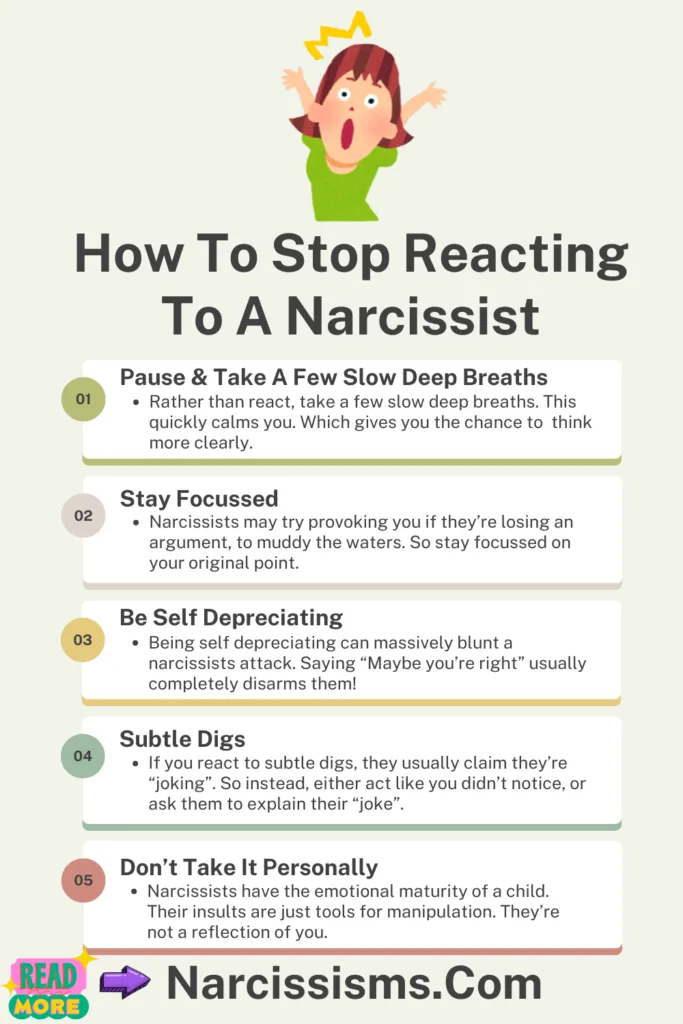
Frequently Asked Questions
Why do I react so strongly to a narcissist?
You may react strongly because narcissistic behaviour can trigger feelings of fear, rejection, injustice, and confusion. After repeated manipulation, your nervous system may be conditioned to respond quickly to perceived threats.
Do narcissists want you to react?
Many narcissists seek emotional reactions because attention, conflict, and emotional intensity gives them a sense of control and importance.
Does ignoring a narcissist make them stop?
Ignoring a narcissist may reduce attempts to provoke you, but it doesn’t guarantee they’ll change their behaviour. The main benefit is that you protect your own emotional well being.
How long does it take to stop reacting to a narcissist?
Everyone is different. If you experienced a long period of manipulation or emotional abuse, it may take time to rebuild confidence and emotional control. Healing is a process, not a single decision. But you will improve with time and effort.
Please CLICK HERE For The Signs You’re Healing From A Narcissist