One of the hardest parts of recovering from narcissistic abuse is feeling safe again. That’s because your mind and body can still believe you’re in danger, long after the relationship ends.
A slammed door makes you jump. Your stomach churns when the phone rings. You analyse every conversation, worried you’ve upset someone. And constantly feel dread that something bad is about to happen.
If this sounds familiar, you’re not imagining it. Narcissistic abuse changes how your nervous system responds to the world.
The good news is that these reactions aren’t permanent. With patience, self compassion, and the right strategies, you can teach your mind and body that you no longer need to live in survival mode…
Please Watch The Following Short Video To Aid Your Understanding…
Why You No Longer Feel Safe
Safety isn’t just about physical danger. Real safety is emotional. It’s knowing you can express yourself without punishment. Make mistakes without being humiliated. And have your needs respected.
Narcissists slowly destroy your sense of security. You may have experienced…
- Constant criticism
- Unpredictable mood swings
- Silent treatment
- Gaslighting
- Threats or intimidation
- Love bombing followed by rejection
Eventually your brain learns that something could go wrong any moment. Which keeps your nervous system on permanent alert. Even after the narcissist has gone, your body hasn’t yet realised the danger has passed.
Please CLICK HERE For 20 Common Trauma Responses After Narcissist Relationships
Understanding Hypervigilance
Many narcissist survivors become hypervigilant. Hypervigilance means your brain constantly scans for threats. You might…
- Read hidden meanings into conversations
- Expect people to get angry without warning
- Feel unable to relax
- Startle easily
- Keep replaying conversations in your mind
- Feel anxious in peaceful situations, because they seem “too quiet”
This isn’t weakness. It’s your brain trying to protect you by using survival skills that once kept you safe. The problem is that these survival skills are only supposed to be short term fixes. So they can be exhausting in the long term.
Please CLICK HERE For How To Reduce Anxiety After A Narcissist Relationship
Give Yourself Permission To Feel Safe
This sounds simple, but many survivors struggle with it. After months or years of manipulation, safety can feel uncomfortable. Because you’re not used to it.
Calm feels unfamiliar. Peace may feel boring. And kindness seems suspicious.
You may find yourself waiting for the next argument, because your nervous system is so accustomed to them. Healing means letting yourself experience peace without believing something bad is about to happen.
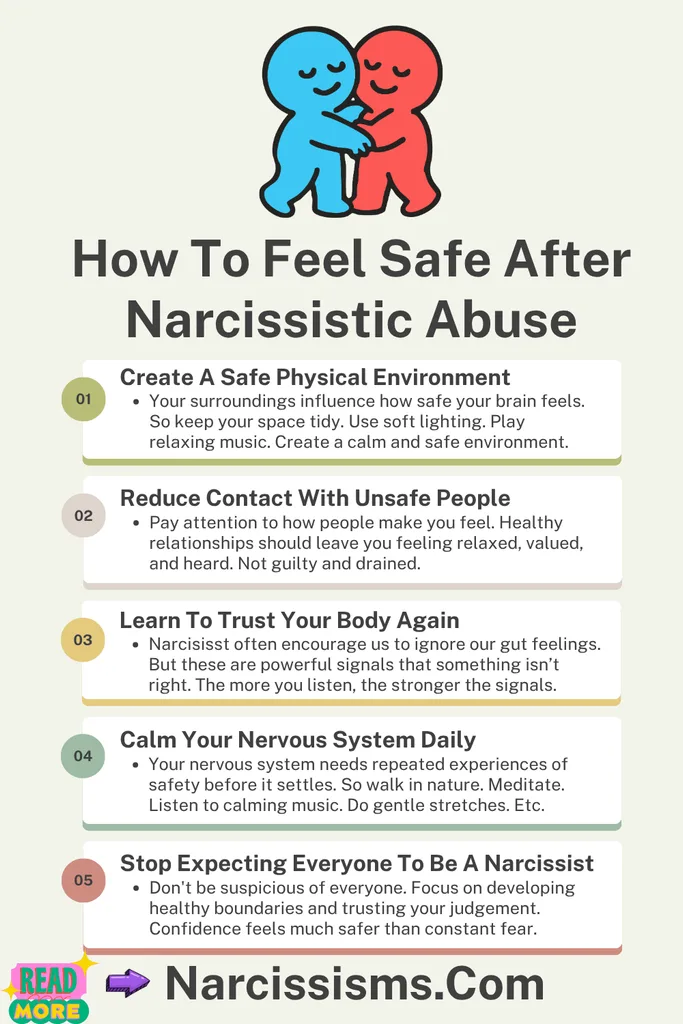
Create A Safe Physical Environment
Your surroundings influence how safe your brain feels. Small changes can make a surprising difference. Consider creating a home that feels calm, by…
- Keeping your living space tidy
- Using soft lighting
- Playing relaxing music
- Surrounding yourself with comforting objects
- Spending time in nature
- Creating a peaceful evening routine
These habits send repeated signals to your nervous system that life is getting safer and more predictable. Which helps you calm over time.
Reduce Contact With Unsafe People
Feeling safe isn’t just about avoiding narcissists. It’s also about limiting exposure to anyone who keeps making you feel anxious, criticised, or emotionally drained.
Pay attention to how people make you feel. Healthy relationships should leave you feeling relaxed, valued, and heard. Unhealthy relationships leave you feeling guilty, drained, and afraid of saying the wrong thing.
Your feelings are valuable information. You don’t need dramatic proof before deciding someone isn’t healthy for you. And you don’t need a diagnosis. Deep down you usually know.
A big sign is how you react when their name appears on your phone. Do you eagerly reach out to answer? Or does your stomach churn, heart race, and you reluctantly pick up the phone with a sigh?

Learn To Trust Your Body Again
Many survivors stop trusting their own gut feelings. And this is no accident.
Narcissists repeatedly tell us we’re too sensitive, overreacting, or imagining things. Over time, you learn to ignore your instincts, because the narcissist convinces us they’re wrong.
This lets narcissists get away with more. Because although things may not feel right, you no longer question those feelings.
Part of healing is reconnecting with your body’s signals. Ask yourself…
- Do I feel relaxed around this person?
- Does my body tense up?
- Do I feel free to be myself?
- Am I constantly monitoring their reactions?
Your body often notices danger well before your logical mind. That’s because our logical conscious mind is slower than our subconscious bodily reactions.
We don’t have time to logically think when we’re in dangerous situations. Our body must react immediately to the perceived danger. Because every second counts.
Listening to your gut feelings is a powerful part of recovery. Because it gives you back your natural detection system.
Calm Your Nervous System Daily
Healing isn’t just a mental process. It’s also physical.
Your nervous system needs repeated experiences of safety before it settles. Helpful practices include…
- Deep breathing
- Mindfulness meditation
- Gentle yoga
- Walking in nature
- Stretching
- Journaling
- Listening to calming music
The goal isn’t to eliminate anxiety overnight. It’s to gently teach your body that it doesn’t need to stay on high alert. Check out my free simple guided meditation bellow…
Please CLICK HERE For My Collection Of Guided Meditation Sessions
Build Small Experiences Of Safety
Confidence grows through experience. Rather than completely changing your life in one go, create small moments where you prove to yourself that you’re safe. Examples include…
- Going for a peaceful walk
- Sitting in a café alone
- Saying “no” to a small request
- Trying a new hobby
- Spending time with supportive friends
- Taking yourself on a day trip
Each positive experience is evidence that life is now safer. So your brain gradually updates its expectations.
Stop Expecting Everyone To Be A Narcissist
This can be difficult to navigate, because you rightly want to avoid more narcissists. But at the same time, you don’t want to alienate yourself from everyone.
Remember, healing isn’t about believing everyone is dangerous. It’s about becoming confident in your ability to recognise unhealthy behaviour, and protect yourself. Ultimately it’s about trusting you to keep yourself safe.
You don’t need to be suspicious of everyone. Just focus on developing healthy boundaries and trusting your own judgement. Confidence feels much safer than constant fear.
Please CLICK HERE For How To Set Boundaries With Narcissists
Be Patient With Your Healing
Many survivors get frustrated because they think they should “be over it” by now. But healing doesn’t follow a straight line.
Some days you’ll feel strong. Other days a memory, or a song may trigger old emotions.
This doesn’t mean you’re back to square one. Recovery often happens in layers. Each time you process another layer, your sense of safety grows stronger.
Please CLICK HERE For The Signs You’re Healing From A Narcissist
Celebrate Every Sign Of Progress
Healing often happens quietly. Perhaps you’ve noticed that…
- You’re sleeping better.
- You don’t constantly check your phone.
- Loud noises don’t startle you as much.
- You laugh more.
- You enjoy your own company.
- You trust your decisions more.
- You no longer feel responsible for everyone else’s emotions.
These small victories matter. They show that your nervous system is starting to believe that you’re safe. And now, you’re learning to thrive.
Final Thoughts
Feelings of safety don’t come all at once. They return gradually, each time you choose peace over chaos, self compassion over self criticism, and healthy relationships over toxic ones.
Every calm breath, every boundary you set, and every decision to trust yourself, is another step away from survival mode.
You deserve a life where your heart isn’t constantly racing. Where your home feels peaceful. And your mind has permission to rest.
This future is possible. And every step you take towards healing brings you closer. Check out my large and growing collection of resources to help you heal here…
Please CLICK HERE For My FREE Narcissistic Abuse Recovery Roadmap
Frequently Asked Questions
How long does it take to feel safe again after narcissistic abuse?
There’s no set timeline. Recovery depends on factors such as the length of the relationship, the severity of the abuse, your support network, and the healing work you do. Many people notice gradual improvements over months, while deeper healing can take longer.
Why do I still feel anxious even though the narcissist has gone?
Your nervous system may still be responding as if you’re living in the abusive environment. This is a common trauma response. With time and consistent self care, your brain can learn that you’re safe.
Is it normal to feel unsafe in healthy relationships?
Yes. Healthy relationships can initially feel unfamiliar after narcissistic abuse. You may expect criticism or manipulation because that’s what you’ve experienced before. As trust grows, these fears lessen.
Can therapy help me feel safe again?
Many survivors find therapy beneficial, particularly approaches that are informed by trauma. A supportive therapist can help you process your experiences, regulate your nervous system, and rebuild trust in yourself.
Will I ever stop being hypervigilant?
For most people, hypervigilance decreases significantly with healing. As your brain has more experiences of safety, it gradually stops scanning for danger all the time. The process takes patience, but lasting improvement is possible.
9 thoughts on “How To Feel Safe After Narcissistic Abuse”