Despite getting rid of the narcissist, your mind and body can still act like they’re here. You still check people’s moods, avoid conflict, and question your own judgement.
These are understandable responses that once helped you avoid danger. But at the same time, they can seriously affect your quality of life.
To resolve your trauma, you must first recognise it. Then you can work on it. If you’re unaware of these responses, they can persist for years. See if any of these apply to you…
Here’s 20 common trauma responses after narcissistic abuse…
Please Watch The Following Short Video To Aid Your Understanding…
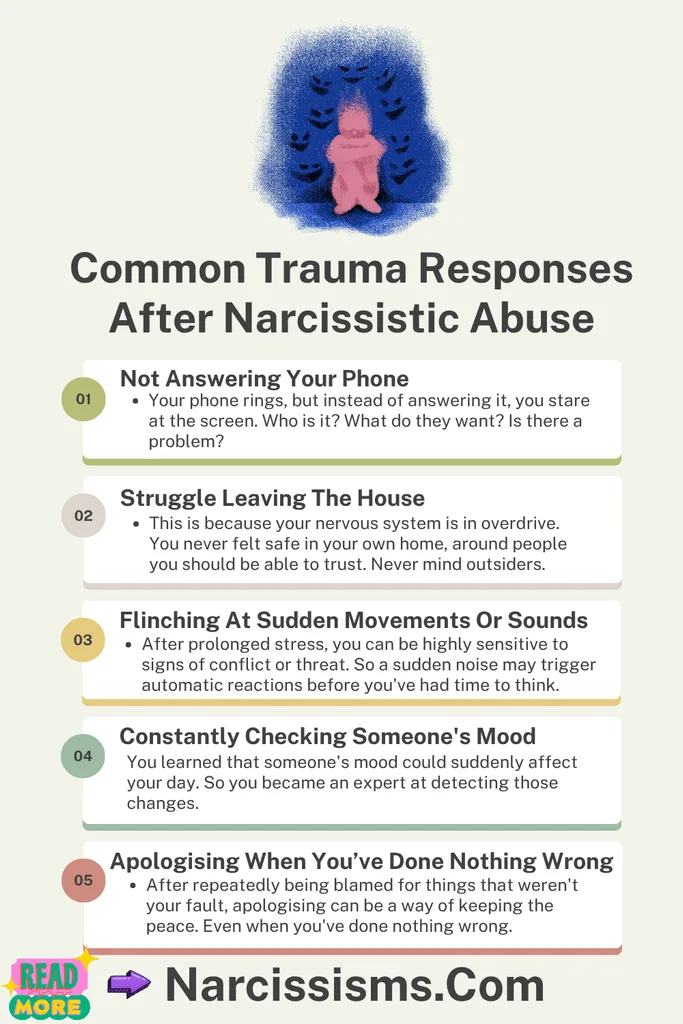
Not Answering Your Phone
Your phone rings, but instead of answering it, you stare at the screen. Who is it? What do they want? Is there a problem?
If you’ve spent years associating phone calls with criticism, demands, and arguments, then you may avoid them altogether.
You might let calls go to voicemail, leave messages unanswered, and feel a wave of dread every time your phone rings. Even when there’s no reason to be anxious.
Struggle Leaving The House
You’re about to leave the house. But as your hand touches the door, your stomach churns and your heart races.
Sometimes you brave these feelings to get the job done. Other times it’s too much. So you retreat back indoors.
This happens because your nervous system is in overdrive. You never felt safe in your own home, around people you should be able to trust. So how can you expect to feel safe among strangers in the outside world?
Please CLICK HERE For How To Feel Safe After Narcissistic Abuse
Scanning The Room
You walk into a room and immediately look around. Who’s here? What’s their mood?
Does anyone look angry? Is anyone upset with you? This kind of scanning can be automatic after narcissistic abuse.
When you’ve had to constantly monitor other people’s expressions, tone of voice, and body language to work out whether you’re safe, you may keep doing it long after the relationship has ended.
Clenching Your Jaw
You might not even realise you’re doing it. But your jaw is tight.
Your teeth are clenched. Your shoulders are raised. Your muscles around your neck and shoulders feel tight.
Living in a stressful environment can leave your body in a prolonged state of tension. But even when the source of the stress has gone, your body still takes time to relax.
This tension can spread all over your body. Causing stiffness, and ache and pains. I found yoga helped me release this physical tension. Particularly in my lower back and hips.
Please CLICK HERE For How Yoga Helps Narcissist Victims
Flinching At Sudden Movements Or Sounds
You flinch when a door slams. A voice is raised. Or someone suddenly moves towards you.
Sometimes your reaction seems over the top. That’s because your body doesn’t wait for your conscious mind to decide whether something is dangerous. It reacts quickly and instinctively.
That’s why you can know something isn’t dangerous, yet still react like it is.
After prolonged stress, you can be highly sensitive to signs of conflict or threat. So a sudden noise may trigger automatic reactions before you’ve had time to think.
Constantly Checking Someone’s Mood
You walk into your home and notice the atmosphere. Is everyone okay? Is someone annoyed? Has something happened?
You might even ask, “Are you okay?”, even though no one has suggested anything’s wrong.
After narcissistic abuse, you may be highly sensitive to changes in other people’s moods. You learned that someone’s mood could suddenly affect your day. So you became an expert at detecting those changes.
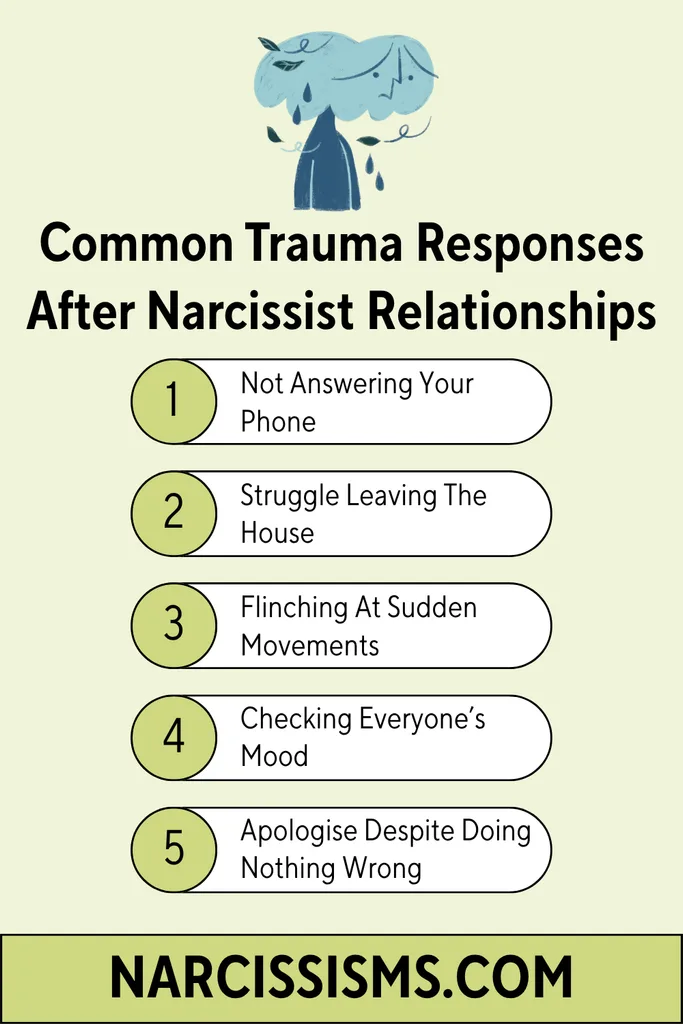
Over Explaining Yourself
Someone asks you a simple question. And you give them a five minute explanation. You explain where you were, why you did something, and what you meant. Why?
It’s because you learned that being misunderstood has consequences. Narcissistic abuse can make you feel like you constantly have to defend yourself.
Eventually, over explaining becomes automatic. So you may find your give evidence for innocent decisions that never needed explaining. Even when you’re ill…
Downplaying When You’re Ill Or In Trouble
You could be at deaths door, but you claim you’re “fine” when asked how you are. That’s because narcissists train you not to be ill.
You’re human so of course you will sometimes be ill. But the narcissist doesn’t want to hear it. So they may ridicule you, or get angry when you mention being ill. Hoping you never mention it again.
That’s because you might expect them to help you. And in their mind that’s not how the relationship should be.
Apologising When You’ve Done Nothing Wrong
You may have learned that saying sorry was safer than arguing about who did it. So if someone bumps into you…
“Sorry.”
Someone is upset…
“Sorry.”
You disagree with someone…
“Sorry.”
You ask for something you need…
“Sorry.”
After repeatedly being blamed for things that weren’t your fault, apologising can be a way of keeping the peace. Even when you’ve done nothing wrong, and you both know it.
Rehearsing Conversations In Your Head
You have a conversation tomorrow. So you start preparing for it today.
You imagine what they might say. You think about how you’ll respond. You run through all the scenarios. Then you do it again, and again.
This can happen when you’ve learned that conversations can quickly turn into arguments or manipulations. So your mind prepares for every possible outcome, so it’s not caught off guard.
Feeling Guilty When Saying No
Someone asks you to do something. You find it unreasonable, so you say no. Then you immediately feel guilty. So you start to question your decision…
“Was I being selfish?”
“Should I have just done it?”
“Maybe I should change my mind.”
If your boundaries were repeatedly challenged or punished by a narcissist, then saying no may be associated with conflict. So even a perfectly reasonable boundary can trigger guilt.
Please CLICK HERE For How To Say No Without Feeling Guilty
Second Guessing Yourself
You make a decision. Then you question it.
You remember a conversation. Then you question your memory.
You express an opinion. Then you wonder if you were wrong.
Gaslighting can undermine someone’s confidence in their own perceptions. After experiencing it repeatedly, you may keep doubting yourself long after the narcissist has gone.
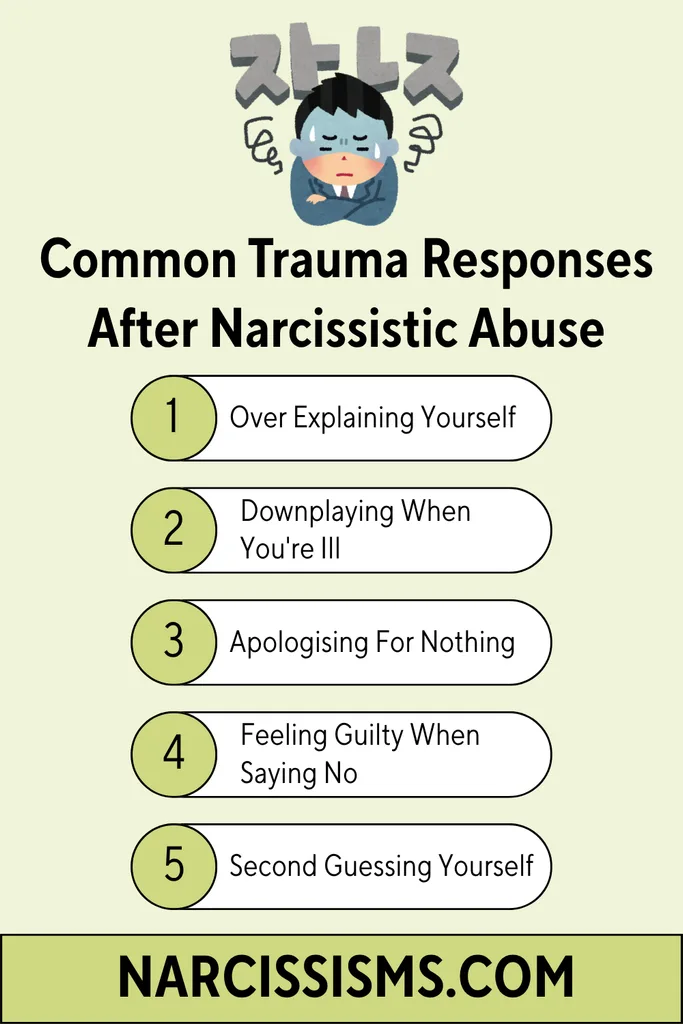
Becoming Sensitive To Tone Of Voice
Someone says “Okay” and you immediately notice the tone. Was that an angry “okay”? A sarcastic “okay”? Are they annoyed? Did I do something wrong?
When you’ve spent a long time trying to detect danger through someone’s voice, you can be super sensitive to subtle changes in tone.
You may hear things that other people wouldn’t even notice. Then spend the next hour wondering what it meant.
Avoiding Confrontation
You know you need to say something. But you don’t. You let things slide.
You tolerate behaviour you don’t like. Because you’d rather be uncomfortable than risk an argument.
After narcissistic abuse, confrontation can feel more threatening than it actually is.
You’ve experienced what happens when you challenge someone who refuses to accept responsibility. So your brain reasons that avoiding confrontation is safer.
This was probably a wise policy with the narcissist. But unfortunately we often carry this on in other relationships.
Feeling Responsible For Other People’s Emotions
Someone is unhappy. So you immediately wonder what you did wrong.
Someone is angry. You feel responsible for calming them down.
Someone is disappointed. You feel guilty.
This can happen when you’ve spent years feeling responsible for a narcissist’s emotions.
You may have learned that keeping the narcissist happy was your responsibility. Which can again continue into new relationships.
Difficulty Making Simple Decisions
“What do you want for dinner?” You don’t know.
“What do you prefer?” You can’t decide.
“Where should we go?” You say, “I don’t mind.”
This may seem insignificant. But repeatedly having your preferences dismissed, criticised, or used against you can make you lose confidence in your choices.
You may be accustomed to prioritising other people’s preferences, because it feels safer than expressing your own. So when you’re asked what you want, you don’t know.
Instead your mind automatically tries to work out what they want you to want. Rather than what you actually want.
Looking For Hidden Meanings
Someone makes an innocent comment. But you start analysing it.
“Why did they say it like that?”
“What did they really mean?”
“Was that a dig?”
“Are they trying to tell me something?”
When you’ve been exposed to manipulation and hidden hostility, you may be accustomed to looking beneath the surface of what people say.
Unfortunately, this can make ordinary interactions exhausting. As you keep searching for threats when none exist.
Finding It Difficult To Relax
Everything is fine. There’s no arguments. No one is angry. Yet you still can’t relax.
You might feel like something is about to happen in the pit of your stomach. Or you find yourself constantly looking for the next problem.
Living with narcissists can teach you that calm is only temporary. So when things are peaceful, your body may struggle to accept it.
Difficulty Sleeping
Unsurprisingly, may people from narcissist relationships struggle with sleep. They either struggle to get to sleep, or they struggle maintaining it.
This is because your body is in flight or fight mode. So the cortisol in your system keeps you wired for action. Sadly this can continue long after the relationship has ended.
Please CLICK HERE For Tips To Help You Sleep
Wanting To Escape Or Withdraw
Sometimes you just want to get away from everyone. You don’t want to talk. You don’t want to explain anything. You just want to be left alone.
After prolonged emotional stress, withdrawal can feel like the safest option. Being alone means no one can criticise you, demand something from you, or get angry with you.
Final Thoughts
One of the most confusing things about narcissistic abuse is that the fall out can continue long after the relationship ends.
For a long time, you had to anticipate problems before they happened. So you learned to read moods, avoid conflict, and keep the peace.
These behaviours may have helped you in the past. But now they hamper the quality of your life.
The good news is that behaviours learned in one environment don’t have to stay with you forever. With time, safety, and healthier relationships, you can learn something very different…
You don’t have to monitor everyone else’s mood.
You don’t have to explain every decision.
You don’t have to apologise for having needs.
Sometimes healing means teaching your body what your mind already knows – The narcissist is gone, so you no longer have to live by their rules.
Please CLICK HERE For My BIG Collection Of Resources To Help You Heal From Narcissistic Abuse
7 thoughts on “20 Common Trauma Responses After Narcissistic Abuse”