There comes a point in narcissist relationships when you realise nothing is working. You’ve explain yourself countless times. You compromise. You give them chances. Yet every conversation leaves you confused, anxious, and emotionally drained.
Blocking a narcissist can feel like a drastic step. It may even feel cruel. But if someone repeatedly manipulates, controls and emotionally abuses you, then blocking them isn’t revenge. It’s self protection.
If you’re struggling with guilt for blocking a narcissist, then this guide will help you understand why you feel guilty, and how to move past it…
Please Watch The Following Short Video To Aid Your Understanding…
Why Blocking Narcissists Feels Difficult
Most people don’t feel guilty for blocking someone who treats them badly. So why does it feel different blocking narcissists?
It’s because narcissists condition people to put their needs before their own. Over time, narcissists train you to believe that…
- You’re responsible for their happiness.
- You’re responsible for fixing every conflict.
- Setting boundaries is selfish.
- Saying “no” makes you a bad person.
- Walking away means you’ve failed them.
After months of hearing these messages, your brain starts accepting them as truth. So when you finally decide to block them, you naturally feel guilty.
Guilt doesn’t mean you’re making the wrong decision. It means you’ve been conditioned to ignore your own needs.
Guilt Doesn’t Mean You’re Doing Something Wrong
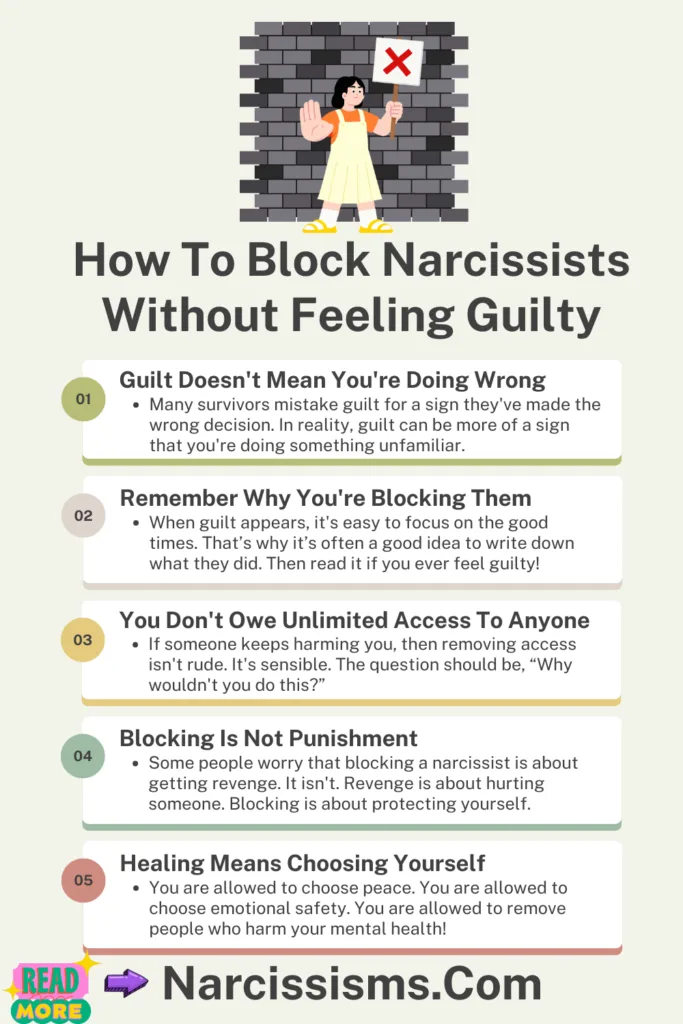
Many survivors mistake guilt for a sign they’ve made the wrong decision. In reality, guilt can be more of a sign that you’re doing something unfamiliar.
Think about someone who’s always been a people pleaser. The first time they stand up for themselves, they feel guilty. Not because setting boundaries is wrong. But because it’s new to them.
Blocking a narcissist can feel the same. You’re breaking an unhealthy pattern. But at the same time you’re doing something unfamiliar. So your nervous system gets triggered, because you’re in unfamiliar territory.
Remember Why You’re Blocking Them
When guilt appears, it’s easy to focus on the good times. This is especially true if you’ve experienced a trauma bond. Your brain conveniently forgets the lies, manipulations, and broken promises.
Instead, you remember the odd moments they were loving or charming. This is why it helps to keep a written list of why you’re leaving. Include specific incidents!
When guilt creeps in, read the list. Facts are more reliable than your feelings during moments of emotional weakness.
Please CLICK HERE For 10 Examples Of Narcissist Text Messages
You Don’t Owe Unlimited Access To Anyone
Many people believe that blocking is rude. But healthy relationships don’t depend on unlimited access.
Healthy people respect boundaries. Narcissists often don’t.
If someone keeps using phone calls, texts, or social media to manipulate, intimidate or upset you, then removing access isn’t rude. It’s sensible. The question should be, “Why wouldn’t you do this?”
You have every right to determine who has access to your life. Blocking someone is just one way of enforcing that decision.
I’m sure you wouldn’t want to be in someone’s life who doesn’t want you in it. So why let someone force their way into yours?
Expect Guilt To Fade
One of the biggest mistakes people make is assuming they’ll always feel guilty. You probably won’t.
Most survivors notice something surprising after several weeks of no contact. The constant anxiety begins to fade.
They sleep better. Stop checking their phone all the time. And start laughing again. That’s because your nervous system is finally getting a chance to recover.
Don’t Confuse Compassion With Self Sacrifice
Many narcissists have difficult childhoods, or unresolved emotional wounds. Knowing this can create sympathy, which narcissists often encourage. You may think…
“They’ve had a hard life.”
“They can’t help it.”
“They need me.”
Compassion is a wonderful quality. But compassion doesn’t require you to stay in abusive relationships.
Empathy is the gel that binds us together. But narcissists can abuse your empathy if you let them. If you extend too much kindness to your own detriment, then it can morph into toxic empathy.
You can wish someone well while also protecting yourself. Both things can be true at the same time.
A hard past doesn’t give anyone the right to abuse others. It’s their responsibility to put in the work to stop doing this. You have no obligation to put yourself in jeopardy for other people’s problems. They won’t do the same for you!
Blocking Is Not Punishment
Some people worry that blocking a narcissist is about getting revenge. It isn’t.
Revenge is about hurting someone. Blocking is about protecting yourself.
Your goal isn’t to make them suffer. Your goal is to stop your suffering. That’s a very important distinction.
Some narcissists will claim that your no contact is you ghosting them. As if you are punishing them for no reason. But this is a ruse to guilt you into taking them back.
Ghosting is about punishing the other person. Whereas no contact is about protecting yourself. This is an important distinction we need to get in our head…
Please CLICK HERE For The Difference Between Ghosting And No Contact
Be Prepared For Hoovering
Narcissists may not disappear for long when they’re blocked. Instead, they look for ways to regain access. This is often called “hoovering”. They may…
- Use different phone numbers or social media accounts.
- Contact your friends or family.
- Promise they’ve changed.
- Claim they have an illness or emergency.
- Artificially cause an argument to get your response.
These attempts are designed to reopen communication. Rather than right any wrongs. So always remember why you blocked them in the first place.
A genuine apology is followed by long term behavioural change. Not desperate attempts to bypass your boundaries.
Yes the narcissist is likely to present as “nice” for a while. But that’s only to reel you back in. They almost always revert to type, once their feet are back under the table.
Please CLICK HERE For More Narcissist Hoovering Tactics
You Don’t Need Their Permission To Leave
One of the hardest beliefs to overcome is thinking you need the narcissist to agree with your decision. You don’t.
They may accuse you of being selfish or cruel. But these accusations often reinforce why blocking was necessary.
Narcissists usually like to keep people in their lives. Because people are useful to them. Remember, narcissists always take more than they give. So their life is almost always better, the more people that are in it.
Practical Ways To Reduce Guilt
If you’re finding it difficult, try these strategies…
1. Write Down Your Reasons
Keep a journal listing every reason you chose to block them. Read it if you ever doubt yourself.
2. Stop Checking Their Social Media
Even if they’re blocked, it’s tempting to keep looking. Narcissists often anticipate this, and post things to manipulate you. This only prolongs the emotional attachment.
3. Talk To Supportive People
Friends, family or therapists can remind you why you made your decision. Isolation often strengthens guilt. Support weakens it.
4. Accept That They May Never Understand
You don’t need validation from someone who repeatedly invalidated you. Their understanding isn’t required for your healing.
5. Focus On Your Future
Instead of wondering how they’re feeling, ask yourself…
“What can I do today to help me recover?”
This question shifts your attention back where it belongs… on your well being. Why put your energy into them?
What If You Have Children Together?
Blocking isn’t always possible. Especially if you share children. In those situations, aim for limited contact, rather than no contact. Keep communication…
- Brief.
- Factual.
- Child focused.
- Emotionally neutral.
Don’t argue. Don’t defend yourself. Don’t respond to personal attacks. The less emotional fuel you give them, the less opportunities there are for manipulation.
Please CLICK HERE For My Tips For Co-Parenting With A Narcissist
Healing Means Choosing Yourself
One of the greatest tragedies of narcissistic abuse is that victims often feel guilty for protecting themselves. Meanwhile, the narcissist rarely feels guilty for hurting others.
Healing involves reversing that imbalance. You are allowed to choose peace. You are allowed to choose emotional safety. You are allowed to remove people who harm your mental health.
Blocking someone doesn’t make you cold. It doesn’t make you cruel. And it certainly doesn’t make you a bad person.
Sometimes, it means you’ve decided that your well being matters too. That’s not selfish. And it’s not cruel. It’s healthy and right.
Please CLICK HERE For How To Heal After A Narcissist Relationship
Frequently Asked Questions
Is blocking a narcissist immature?
No. Blocking is a boundary. If someone repeatedly ignores your boundaries, then blocking may be the healthiest way to protect your emotional well being.
Why do I feel guilty after blocking them?
Years of manipulation, guilt tripping and people pleasing can make healthy boundaries feel uncomfortable. Guilt doesn’t necessarily mean you’ve done anything wrong.
Should I tell a narcissist I’m blocking them?
In most cases, no. Explaining your decision can give them a chance to argue, manipulate and guilt trip you. If your safety or well being is at risk, you don’t owe an explanation.
Will a narcissist come back after being blocked?
Many do attempt to reconnect through hoovering. Especially if they believe they can regain control or gain attention. Staying consistent with your boundaries is usually the best way to protect your progress.
How long does the guilt last?
Everyone is different, but many survivors find that guilt fades over time, as they experience more peace, confidence and emotional clarity. The longer you maintain healthy boundaries, the easier they become.
Please CLICK HERE For Why You Shouldn’t Feel Guilty For No Contacting Narcissists
1 thought on “How To Block Narcissists Without Feeling Guilty”
Comments are closed.