Co-parenting usually comes with difficulties. But co-parenting with a narcissist is another level. Communication is a battleground. Agreements are ignored. And your emotional well being is tested to its limit.
You can’t control a narcissists behaviour, but you can control how you respond. Instead of being drawn into pointless arguments, focus on your child’s needs. Set firm boundaries, develop strategies that reduce conflict, and create a more stable environment for your children.
In this article we’ll look at actionable tactics to help you co-parent with a narcissist…
Please Watch the Following Short Video To Aid Your Understanding…
What Does Co-Parenting With A Narcissist Look Like?
Narcissists often put their own needs above others, even their own children’s. They also struggle accepting responsibility and accountability.
Instead narcissist parents seek admiration, and react poorly to criticism. Not ideal traits for good parents. In co-parenting relationships, this can show up as…
- Ignoring agreed schedules.
- Using the children to manipulate or control the other parent.
- Creating unnecessary conflict over simple decisions.
- Making false accusations, or rewriting the past.
- Refusing to compromise or collaborate.
- Attempting to undermine your relationship with your child.

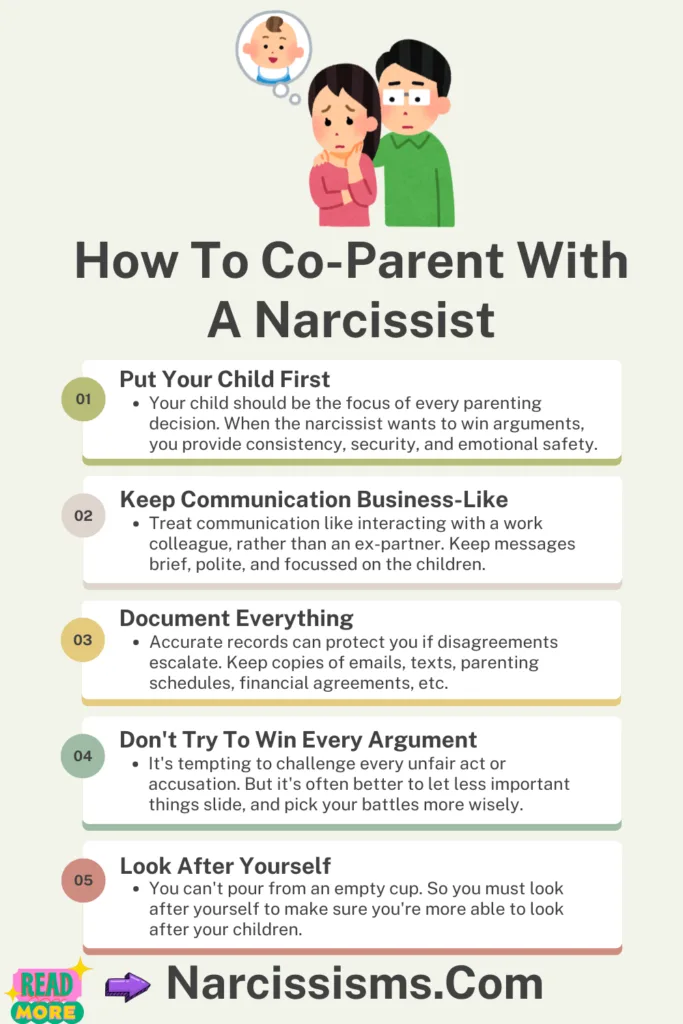
Put Your Child First
Your child should be the focus of every parenting decision. When the narcissist wants to win arguments and gain control, your goal is to provide consistency, security, and emotional safety. As I’m sure you know, children benefit from…
- Predictable routines.
- Clear expectations.
- Emotional reassurance.
- Stable boundaries.
- Loving, calm relationships.
Don’t involve your child in adult conflicts. They should never feel responsible for carrying messages, choosing sides, or managing a parent’s emotions.
Keep Communication Business-Like
One of the most effective strategies for co-parenting with narcissists is to treat communication like interacting with a colleague, rather than an ex-partner. Keep messages brief, polite, and focussed on the children.
Avoid defending yourself, arguing, or responding emotionally to personal attacks. High-conflict people want emotional reactions. So refusing to engage reduces conflict. Because they learn that their provocations don’t work. Instead of saying…
“You’re always late because you don’t care.”
Try saying…
“School finishes at 3:15 pm. Can you please let me know if you’ll collect them today?”
The less emotional your communication, the less opportunity there is for conflict. Because there’s less for the narcissist to pick at to create arguments.
It may help to check out the grey rock method for dealing with narcissists. This is a great tool for helping you stay non reactive when you’ve no choice but to deal with a narcissist.
Please CLICK HERE For Examples Of Narcissist Text Messages
Set Firm Boundaries
Boundaries are essential when co-parenting with narcissists, because narcissists often ignore limits. Consider boundaries such as…
- Only discussing parenting issues.
- Refusing to engage in arguments.
- Ending conversations that become abusive.
- Following court orders or parenting agreements exactly as written.
Remember that boundaries are about controlling your own behaviour. Not someone else’s.
Please CLICK HERE For How To Set Boundaries With Narcissists
Document Everything
Keeping accurate records can protect you if disagreements escalate. Keep copies of…
- Emails.
- Text messages.
- Parenting schedules.
- Medical information.
- School communications.
- Missed visitations.
- Financial agreements.
This stops the narcissist from rewriting history to a version that’s more beneficial to themselves, and less to you and your children.
Stick to facts rather than opinions. A clear timeline is often more useful than emotional descriptions of events. Because it provides more solid evidence.
Expect Pushback
When establishing healthier boundaries, you’ll probably experience some resistance. Because they feel a sense of loss. So the narcissist parent may…
- Accuse you of being difficult.
- Attempt to provoke arguments.
- Ignore agreed arrangements.
- Smear you to others.
- Become more controlling.
This doesn’t mean your approach is failing. People used to controlling situations often react negatively when the dynamics change. But eventually they get used to the new dynamic.
Remain calm, consistent, and focused on your child’s well being.
Don’t Try To Win Every Argument
It’s tempting to correct every false statement, or challenge every unfair act or accusation. But it’s often better to let some things slide, and pick your battles more wisely. Otherwise you may find yourself constantly fighting. Ask yourself…
- Does this affect my child’s safety?
- Does it require a legal response?
- Will responding actually improve the situation?
If the answer is no, then it may be better to let these minor provocations pass. This saves energy for issues that truly matter to you and your child.
Help Your Child Feel Safe
Children often notice tension even when adults try to hide it. Create a home where your child feels heard and loved. One where they feel safe expressing their true emotions and opinions.
Don’t ask them to report on the other parent, unless there’s genuine safeguarding concerns. Instead, encourage open conversations by listening without judgement. If they praise the narcissist parent, then let them. Even if it bugs the hell out of you!
Look After Yourself
You can’t pour from an empty cup. So you must look after yourself to make sure you’re more able to look after your children. Prioritise…
- Adequate sleep.
- Regular exercise.
- Healthy boundaries.
- Time with supportive people.
- Activities that reduce stress.
The calmer and healthier you are, the more you can support your child through difficult times.
When To Seek Professional Help
If the narcissist’s behaviour becomes abusive, threatening, or puts your child at risk, seek professional advice immediately. This may include…
- The Police.
- Family law advice.
- Mediation (where appropriate and safe).
- Mental health support.
- Child safeguarding services if necessary.
Trust your instincts if you believe your child’s well being is being compromised. Because as parents, we often know.
Final Thoughts
Co-parenting with narcissists isn’t be straightforward. But you can still create a parenting approach built on stability, consistency, and emotional resilience.
Your child doesn’t need perfect parents. They need at least one who provides safety, reliability, and unconditional love.
By focusing on what you can control, maintaining healthy boundaries, and protecting your own well being, you can give your child the best chance. Even in the midst of the narcissists’ erratic and selfish behaviours.
You can’t be too passive when dealing with narcissists, because they’ll walk all over you. But you can’t be too aggressive either. Or you’ll be in constant conflict.
Instead, learn to be assertive. This is the sweet spot between the two…
Please CLICK HERE For How To Be More Assertive After A Narcissist Relationship