People often leave narcissistic relationships feeling confused. You know the relationship hurt. You know you were manipulated, dismissed, and controlled. Yet somehow… you still miss them.
This emotional contradiction can be a sign of a trauma bond.
A trauma bond is not a normal, healthy attachment. It’s a powerful psychological connection that can develop through cycles of emotional abuse, intermittent affection, fear, hope, and dependency.
Breaking a trauma bond with a narcissist can feel less like “getting over someone” and more like detoxing from an addiction. The pull can be incredibly strong, even when you know the relationship was hurting you.
If you’re trying to break a trauma bond with a narcissist, the first thing to understand is this:
Your attachment doesn’t mean the relationship was healthy or that you should go back.
It means your mind and nervous system adapted to an incredibly confusing and emotionally intense situation.
Understanding why you still feel attached can be an important first step towards finally breaking free…
Please Watch The Following Short Video To Aid Your Understanding…
What Is A Trauma Bond?
A trauma bond develops when periods of emotional pain are regularly interrupted by moments of affection, validation, and intimacy. In narcissist relationships, this often looks like…
- Intense love and attention at the beginning (love bombing).
- Emotional withdrawal and criticism later.
- Cycles of blame, confusion, and reconciliation.
- Occasional affection that keeps you hopefully hanging on.
- Feeling solely responsible for fixing the relationship.
- Becoming emotionally dependent on their approval.
This inconsistency creates emotional conditioning. Your brain starts chasing the “good moments”, even when enduring harm.
This is why some people stay in toxic relationships longer than they should. They’re more focussed on the next hit of niceness, than the bad things that happen most of the time. So leaving can feel emotionally devastating. Even when the relationship was unhealthy.
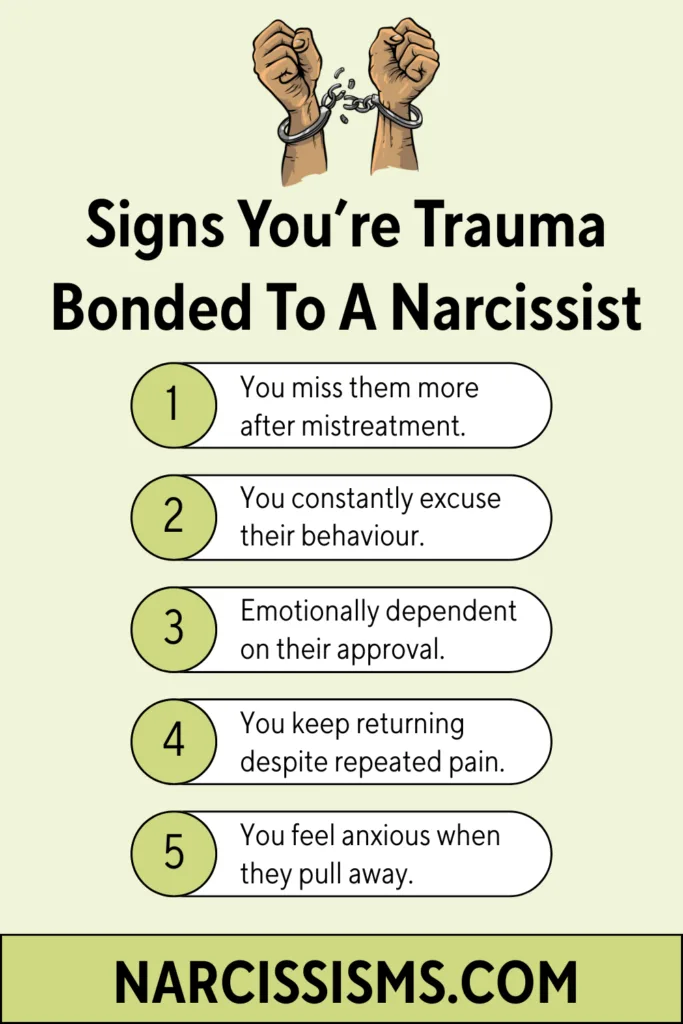
Signs You’re Trauma Bonded To A Narcissist
You may be trauma bonded if…
- You miss them more after mistreatment than after healthy moments.
- You constantly excuse their behaviour.
- You feel emotionally dependent on their approval.
- You keep returning despite repeated pain.
- You feel anxious when they pull away.
- You obsess over getting them to understand your feelings.
- You confuse intensity with love.
- You feel emotionally exhausted, but unable to detach.
One of the most painful parts of trauma bonds is that the relationship feels deeper because it was emotionally destabilising. This is because of all the highs and lows and hormonal changes you went through.
The Truth About Narcissists And Change
Many narcissists make promises to change when they sense they’re losing control of the relationship. Sometimes these promises sound convincing…
- “I’ll do better.”
- “You’re overreacting.”
- “Nobody will love you like I do.”
- “We just need to communicate better.”
- “I’ve changed.”
Temporary improvements are common in toxic cycles. But permanent change is much rarer. For a narcissist to make permanent positive change, they must remain committed to therapy for years. Because as soon they stop, they’re likely to revert back to type.
Sadly narcissists rarely commit to therapy in the long run. Some start therapy to convince people they’ve changed. But as soon as they let them back in their life, they have no need to continue. So they stop.
Of course they don’t admit they stopped because it’s now served its purpose. So they usually blame the therapist for something they decide they did that was “wrong”. Rather than admit they didn’t want to do the work to change.
Please CLICK HERE For My Complete Guide For Rebuilding After Narcissistic Abuse
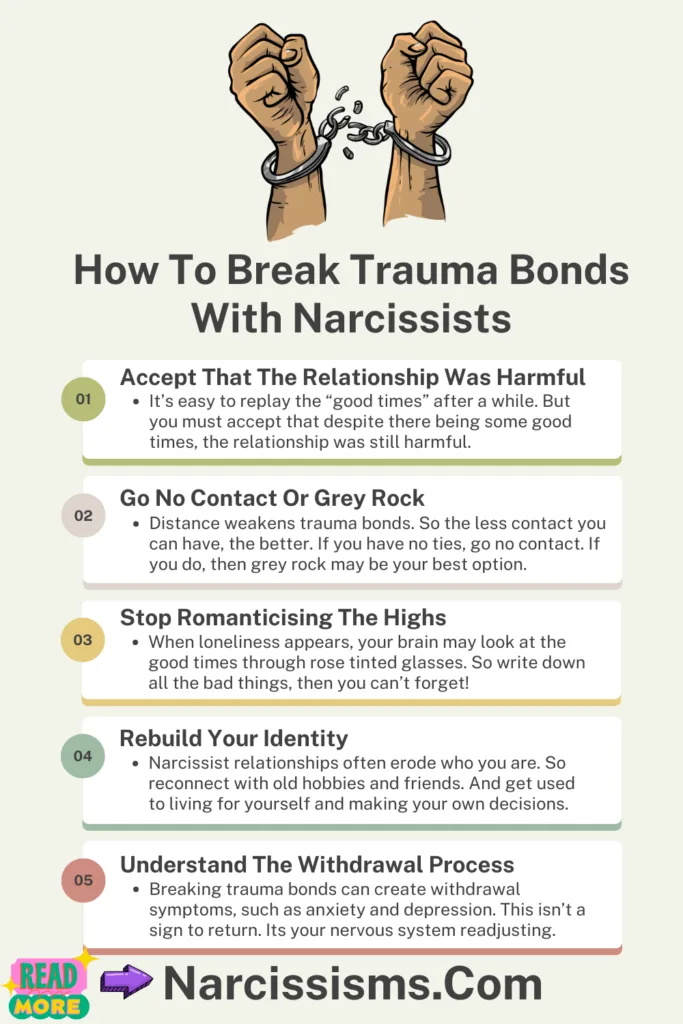
How To Break Trauma Bonds With Narcissists
Healing starts when you stop trying to understand the narcissist, and start reconnecting with yourself…
1. Accept That The Relationship Was Harmful
One of the biggest barriers to healing is emotional bargaining. You may replay…
- The good times.
- Their vulnerable moments.
- Their apologies.
- The love bomb version you hoped they would become.
Healing begins when you stop separating the “good version” from their harmful behaviour. Both existed together. A relationship can’t be healthy if it keeps destroying your emotional stability. Even if there’s moments that are genuinely good.
2. Go No Contact Or Grey Rock
Distance weakens trauma bonds. Every text, social media check, conversation, or attempt at closure can reactivate the attachment cycle. No contact gives your nervous system a chance to stabilise.
If you share children or other ties, then grey rock might be a better option. This can include…
- Limiting communication to essentials.
- Avoiding emotional discussions.
- Using written communication only.
- Refusing to engage in blame cycles.
Please CLICK HERE If You Want To learn More About The Grey Rock Method
3. Stop Romanticising The Highs
Trauma bonds thrive on selective memory. When loneliness appears, your brain may replay all the good times through rose tinted glasses.
What often gets minimised is the anxiety, confusion and walking on egg shells. So write down a list of what actually happened during the relationship. Then read it whenever nostalgia distorts your reality!
4. Rebuild Your Identity
Narcissistic relationships often erode self trust. You may lose…
- Confidence.
- Hobbies.
- Friendships.
- Boundaries.
- Emotional clarity.
- A sense of who you are.
Healing requires reconnecting with your own life. Start small…
- Reconnect with supportive people.
- Return to activities you once enjoyed.
- Create routines that feel grounding.
- Practice making decisions for yourself.
- Spend time without explaining or defending your emotions.
Your identity deserves space outside of survival mode.
5. Understand The Withdrawal Process
Breaking trauma bonds with narcissists can create emotional withdrawal symptoms, such as…
- Anxiety.
- Craving to contact them.
- Depression.
- Obsessive thoughts.
- Emotional numbness.
- Panic and loneliness.
This doesn’t mean you should return. It usually means your nervous system is adjusting to life without chaos and intermittent reinforcement. So healing can feel uncomfortable before it feels peaceful.
You Do Not Need Their Validation To Heal
Many survivors stay emotionally attached because they want acknowledgement. Such as an apology or closure. But narcissists usually avoid accountability, because it threatens their superior self image.
Narcissists are unlikely to admit they did anything wrong. Unless they want to use a “confession” to reel you back in.
Waiting for validation keeps the trauma bond alive. Because they’re likely to sense they have something you want. So they can dangle the carrot of offering you validation, then snatch it away. Keeping you around. They’re also likely to lie to make themselves look better, and find ways to make things your fault.
The best closure you can get is learning as much as you can about narcissism. Because this will help you work out what the narcissist was actually up to. Far more than they’ll ever admit.

What Healing Eventually Feels Like
At first, peace may feel strange and unfamiliar. You may mistake calmness for emptiness, because your nervous system is so used to emotional extremes. But over time, healing often brings…
- Emotional clarity.
- Better boundaries.
- Self trust.
- Stability.
- Confidence.
- Healthier relationships.
- Free from constant emotional confusion.
The goal isn’t just to leave the narcissist. The goal is to stop abandoning yourself to love someone else. Because if it was a genuine healthy relationship, you would never need to.
Please CLICK HERE For 20 Common Trauma Responses After Narcissistic Abuse
Final Thoughts
Breaking trauma bonds with narcissists is usually a process of grieving, relearning, and rebuilding. You’re not just ending a relationship. You’re untangling emotional conditioning that taught you to associate love with instability.
Recovery takes time. Some days you may feel strong. Other days you may miss them intensely. What matters is you keep moving forward towards emotional safety, self respect, and truth. Because real love shouldn’t need you to lose yourself to keep someone.
For more help, please check out my tips for healing from a narcissist relationship…
Please CLICK HERE For My Tips For Healing From A Narcissist Relationship