When we think of narcissists, most people picture someone loud, bragging, and self-obsessed. But there’s another form of narcissism that’s less obvious, and often more confusing. That’s the communal narcissist.
Communal narcissism doesn’t look like vanity or bravado. Instead it looks like generosity, kindness, empathy, and moral righteousness.
Communal narcissists present themselves as the most caring, compassionate, and community minded people you’ll ever meet. Yet beneath their polished exterior lies the same set of traits all narcissists possess. That’s entitlement, manipulation, grandiosity, and a desperate need for validation.
Communal narcissists can be particularly damaging, because they attach themselves to good people and good causes. Ruining them in the process.
In this article I’ll explore communal narcissists in more depth. Let’s start with a description of communal narcissism…
Please Watch The Following Short Video To Aid Your Understanding…
What Is Communal Narcissism?
Communal narcissists seek admiration for their “communal” qualities. These are kindness, fairness, altruism, empathy, and moral virtue.
While classic grandiose narcissists want to be admired for being smarter, more successful, or more talented, communal narcissists want to be admired for being “good people.” More good than everyone else.
Their self-image might sound like…
- “I’m the most caring person around.”
- “I always put others first.”
- “No one helps the community like I do.”
- “I make the world a better place, because I’m so selfless.”
Notice the pattern. Their generosity fuels self-promotion. Their empathy is their brand. And kindness becomes a competitive sport. It’s all about them.
Despite appearing compassionate, communal narcissists display the same traits as other narcissists…
- A deep need for admiration
- Hypocrisy
- Self-centeredness
- A lack of real empathy
- Manipulation in relationships
What makes communal narcissists uniquely challenging is that their narcissism hides under the cloak of goodness. Making them harder to spot, harder to challenge, and harder for others to believe their victims.
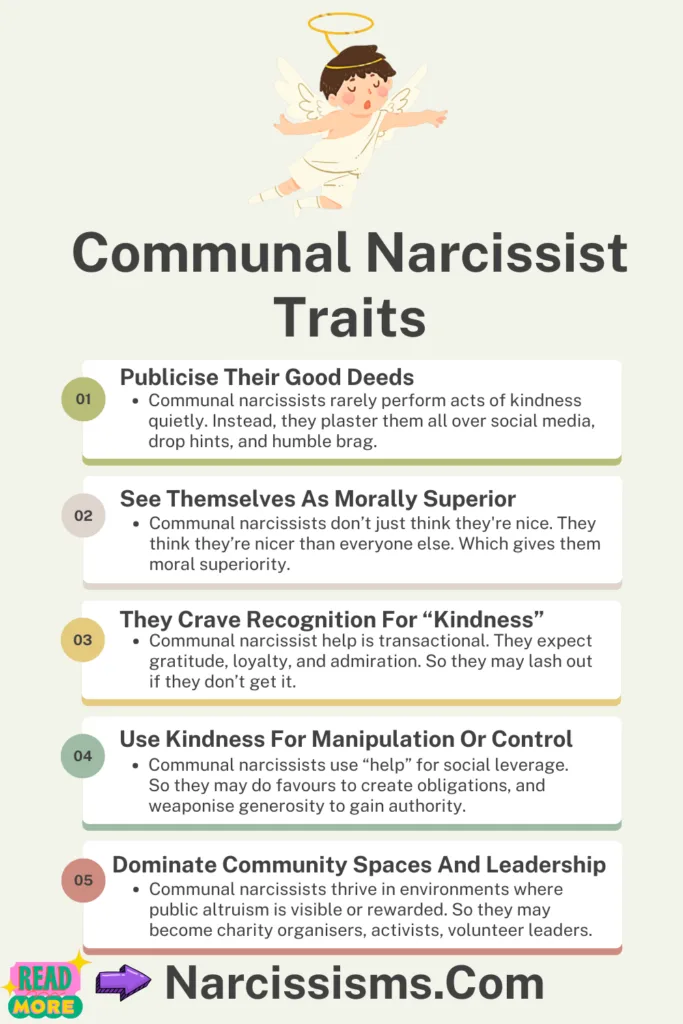
They Publicise Their Good Deeds
Communal narcissists rarely perform acts of kindness quietly or privately. Instead, they…
- Post their charity work all over social media
- Tell stories about how they “saved the day”
- Drop humble-brags in conversation
- Exaggerate their contributions
For them, altruism is not about helping. It’s about being seen as helping. Which means it’s all about them.
Example
A communal narcissist volunteers at a shelter, but spends more time taking photos for social media than actually helping. When no one acknowledges their “sacrifice”, they bring it up repeatedly until someone finally praises them.
Why They Do It
Narcissists crave admiration. So they may publicise their altruism to gain validation, compliments, and social status. For communal narcissists, it’s not worth doing unless people know about it.
They See Themselves As Morally Superior
Communal narcissists don’t just think they’re nice. They think they’re nicer than everyone else. Which gives them moral superiority.
They may say things like…
- “I care more than others do.”
- “I’m the only one who helps around here.”
- “People don’t understand how much I give.”
Their sense of superiority often becomes moralistic and judgemental. They view themselves as the moral authority, and expect others to align with their standards.
Communal narcissists often have an inflated view of their own standards. So they may set impossibly high demands on everyone else. Higher than they reach themselves. Then complain when these standards have not been met.
Impact On Others
People around them may feel inferior, criticised, or subtly shamed for not being good enough. Even though they probably do more good work than the communal narcissist.
They Crave Praise And Recognition For Their “Kindness”
While communal narcissists appear selfless, their help is often transactional. They expect…
- Gratitude
- Loyalty
- Admiration
- Public acknowledgement
If those rewards don’t come, then their “kindness” quickly evaporates. But they’re unlikely to admit the real reason why they’re unhappy. So they may manufacture or exaggerate problems, to give them an excuse to lash out.
Signs to Look For
When they help you…
- Their “favour” gets brought up again and again.
- They exaggerate how much they did.
- They remind you that you “owe” them.
- They get offended if you don’t show enough appreciation.
This shows their kindness has strings attached. And wasn’t done for its own sake.
They Lack Genuine Empathy
Despite presenting themselves as empathetic, communal narcissists often fail to show real emotional understanding.
They may be supportive when it makes them look good, but they often…
- Dismiss emotions that inconvenience them.
- Shift conversations back to their own experiences.
- Offer help that serves them, not you.
- Give poor advice without really listening. Just to tick the box.
Empathy vs. Image
Real empathy is quiet, patient, and humble. Because it’s normal for empathetic people, and no big deal. Communal narcissists make a big show of it, and perform empathy for attention and influence. Because they’re faking it to get their own needs met.
They Use Kindness For Manipulation Or Control
One of the most harmful traits is that communal narcissists use “help” as a form of social leverage.
They may…
- Offer unsolicited help so they can later claim credit.
- Fix things that don’t need fixing.
- Do favours that create obligations.
- Weaponise generosity to gain authority.
- Guilt-trip over past favours – “After all I’ve done for you…”
The Goal
Control. By positioning themselves as essential or heroic, they maintain influence over people and social settings.
Dominate Community Spaces And Leadership Roles
Communal narcissists often thrive in environments where public altruism is visible or rewarded.
They gravitate to roles like…
- Committee chairs
- Volunteer leaders
- Charity organizers
- Activists
- Church group officers
- School board or PTA leaders
Why These Roles Appeal
These roles provide…
- Visibility
- Authority
- Opportunities for praise
- Access to social networks
- Influence over decision-making (power)
However, because communal narcissists motivation is self-focused, they may undermine collaboration, silence dissent, and create toxic environments behind the scenes. Ruining the organisation, and good work of others.
They Have Fragile Self-Esteem Beneath The Surface
Challenges or critiques to their “good person” image can trigger…
- Defensiveness
- Outrage
- Guilt-tripping
- Passive-aggressiveness
- Claims of being misunderstood or mistreated
If someone else receives recognition for helping, they may feel jealous or threatened. And may not be able to help themselves from lashing out, and putting down their efforts.
The Narcissistic Injury
Like all narcissists, communal narcissists can’t tolerate anything that destabilises their inflated self-image. So someone being more “good” than them may trigger them.
This may lead to competitive behaviours. And targeting that person as a rival. But this may be done subtly, with sabotage. Or by gossiping and exaggerating their faults to others.
Exaggerate Their Contributions
Communal narcissists help is purely selfish. They don’t genuinely care about their causes. Which is why they commonly exaggerate…
- How much they helped
- How essential they were
- How much others rely on them
- How much sacrifice they made
In group projects or community roles, they may take credit for others’ work, insisting they carried the heaviest burden. Even if that clearly wasn’t the case.
They Struggle With Genuine Boundaries
Because they see themselves as heroes, communal narcissists may intrude into others’ lives under the guise of helping. So they may…
- Give advice that wasn’t asked for.
- Over step boundaries in personal situations uninvited.
- Insist they know what’s best for others. Even if they don’t know them that well.
- Act offended if someone declines their help. Or doesn’t follow their advice.
Communal narcissists version of “support” can be overbearing, controlling, and inappropriate.
Communal Narcissists In Romantic Relationships
Partners of communal narcissists often describe an emotional disconnect behind the mask of helpfulness.
Common Experiences
- They brag about being a great partner while ignoring your actual needs.
- Their “helpfulness” becomes a tool of control. So they may take over and de skill people around them.
- You may feel guilty or ungrateful if you try to set boundaries.
- They grow resentful if you get attention for something positive you do.
The relationship may feel one-sided, with the communal narcissist always “saving the day”. But they never truly connect or show vulnerability, empathy, or reciprocity.
Communal Narcissists Family Dynamics
In families, communal narcissists may be…
- The parent who sacrifices “everything”, but always reminds their children.
- The person who’s always helping others, but never their own family.
- The sibling who acts morally superior.
- The relative who inserts themselves into everyone’s personal decisions. Using their role as “family helper” to interfere and control.
Communal Narcissists At Work
At work, communal narcissists may…
- Take credit for teamwork.
- Volunteer strategically to climb the ladder.
- Undermine colleagues who outshine them.
- Manipulate through “helpfulness”.
Workplaces may become toxic and competitive due to their behaviour.
Community Or Social Groups
Because they often hold leadership roles, communal narcissists can influence entire communities.
Negative outcomes might include…
- Favouritism
- Burnout among volunteers
- Political power struggles
- Dysfunctional group culture
People may hesitate speaking up, fearing backlash from someone viewed as a pillar to the community.
How To Spot A Communal Narcissist
Look for patterns, not isolated behaviours. You may be dealing with a communal narcissist if…
- Their altruism is always visible and public.
- They talk more about their good deeds than they do them.
- Their kindness has strings attached.
- They get upset when not acknowledged.
- Their empathy disappears when no one’s watching.
- They position themselves as morally superior.
- They subtly control others through “helping.”
- They react poorly to criticism.
Genuine kindness is quiet, steady, and humble. Communal narcissism, by contrast, is loud, controlling, and self-serving.
Please CLICK HERE For Other Different Types Of Narcissists