Recently the term “dark empath” has been appearing across social media. Which often sparks curiosity and confusion.
The confusion is mostly from the contradicting terms. “Dark” is usually associated with bad or evil. Yet “empath” is associated with good.
So, what is a dark empath? Is it a real psychological category?
To understand what a dark empath is, we need to discuss both sides of the term… “empathy” and the “dark” personality traits…
Understanding Empathy
Empathy is usually seen as a positive human trait. It’s the ability to understand and share other peoples’ feelings. Psychologists often divide empathy into two types…
- Cognitive empathy – The ability to recognise and understand someone else’s emotions. It’s where someone logically predicts how someone must be feeling.
- Emotional empathy – The ability to feel what another person is feeling. It’s automatic, gets the person more involved, and requires no conscious effort.
Most people associate empathy with kindness, compassion, and good behaviour. But empathy on its own is morally neutral. It’s a skill. And like any skill, it can be used in different ways.
Please watch the following short video to aid your understanding…
The “Dark” Personality Traits
The “dark” in “dark empath” refers to a cluster of personality traits popularly known as the “Dark Triad”. These are…
- Narcissism – Excessive self-focus, and the need for admiration.
- Machiavellian – Manipulation, and the strategic exploitation of others.
- Psychopathy – Lack of remorse, impulsivity, and shallow emotions.
People high in these dark personality traits prioritise their own interests. Sometimes at the expense of others.
So, What Is A Dark Empath?
A dark empath is a personality that combines higher levels of empathy, particularly cognitive empathy, with dark personality traits.
So they understand how others feel. But they use that understanding for selfish aims.
Unlike the stereotypical cold psychopath that lacks empathy, a dark empath can read emotions well. Which can make them socially skilled, charming, and even likeable at first. However, their empathy doesn’t necessarily lead to kindness. Instead, it’s used as a tool against people.
Key Characteristics Of A Dark Empath
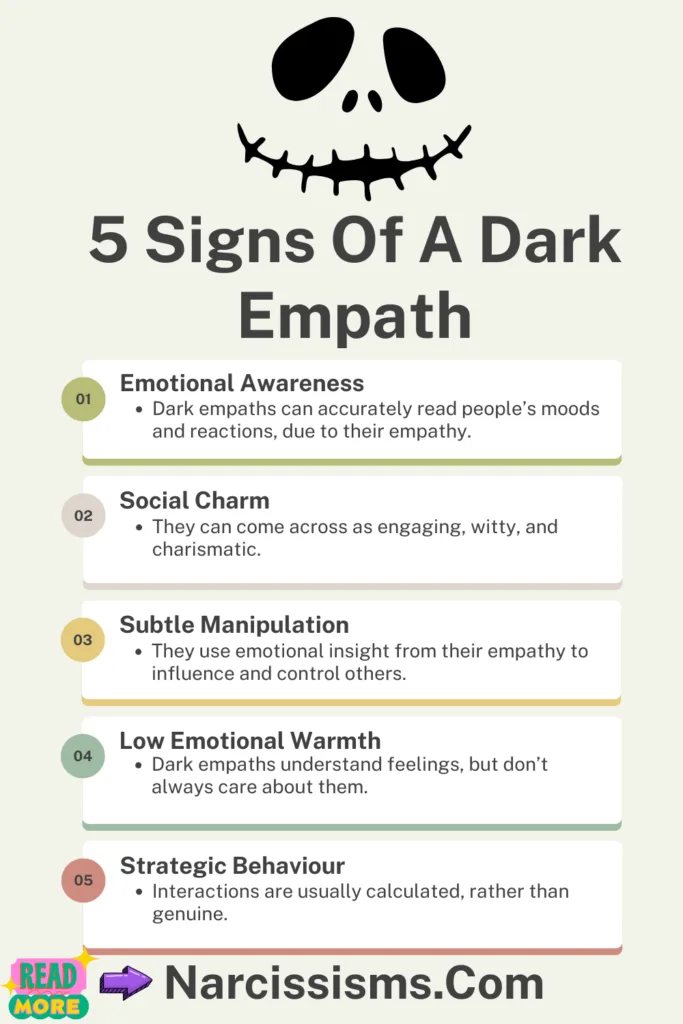
While not an official clinical diagnosis, descriptions of dark empaths usually include…
- Emotional awareness – Dark empaths can accurately read people’s moods and reactions.
- Social charm – They can come across as engaging, witty, and charismatic.
- Subtle manipulation – They use emotional insight to influence and control others.
- Low emotional warmth – Dark empaths understand feelings, but don’t always care about them.
- Strategic behaviour – Interactions are usually calculated, rather than genuine.
Importantly, dark empaths may not seem harmful on the surface. Their behaviour can be more subtle than openly aggressive personalities.
How Dark Empaths Might Behave In Real-World Scenarios
Here’s a few examples of how dark empaths behave in certain roles…
1. In Friendships
You confide in a friend about something that makes you feel insecure. They respond with warmth and understanding. Lovely, but then…
During a later disagreement, they bring up the insecurity to undermine your confidence. Just to “win” the argument.
What’s happening – They used their empathy to gather emotional insight. But it wasn’t to protect or support you. It was to use against you.
2. At Work
A dark empath notices a colleague is stressed about a deadline. So they offer to help.
However, they later present the shared work as their own, to gain recognition from management. Even though they did less than half the work.
What’s happening – They spotted vulnerability, so they created the illusion of helping you. But really it was for self-serving purposes.
3. In Romantic Relationships
Dark empaths are highly attentive early on. They pick up on your needs, preferences, and emotional triggers. Which can feel like a deep connection.
Over time, they use this knowledge to control the dynamics. Such as knowing what to say to keep you attached. Or what to say to make you doubt yourself during conflicts.
What’s happening – Emotional attunement is used as a tool for influence, rather than for mutual care.
4. In Social Groups
Dark empaths can be witty, socially skilled, and read the room well. They may bond well with different people. But at the same time, they subtly stir tension.
They may share selective information, or make carefully crafted comments that cause fights amongst others. All while pretending not to be involved. Which keeps their own image intact.
What’s happening: Their social awareness lets them manipulate group dynamics, to cause trouble amongst others. All without appearing to be involved. They may even try to play the role of mediator.
Why The Term “Dark Empath” Is Gaining Attention
The idea of a dark empath resonates because it challenges the common assumption that empathy always equals goodness. In reality, emotional intelligence can be used both constructively and destructively.
It also helps explain why some people seem emotionally perceptive but can still engage in toxic or manipulative behaviour. This contradiction, being both “understanding” and “harmful”, is what makes the concept so compelling.
Dark Empath vs. Communal Narcissist – What’s the Difference?
When I first encountered the term “dark empath”, it seemed very similar to a communal narcissist. Both appear socially aware, emotionally intelligent, and even caring. However when I dug deeper, their motivations and behaviours differ in important ways…
What Is A Communal Narcissist?
A communal narcissist is someone who seeks admiration and validation by being seen as kind, helpful, and moral. Instead of saying “I’m better than everyone,” their mindset is more, “I’m the most caring and generous person here.”
Key Differences
1. Motivation
- Dark empath– Uses emotional insights as a tool for influence, control, and personal gain.
- Communal narcissist– Wants recognition and praise for being “good” or helpful.
2. Use Of Empathy
- Dark empath– Often has strong cognitive empathy and uses it strategically. Sometimes manipulatively.
- Communal narcissist– May display empathy publicly, but it’s often performative or exaggerated, to maintain an image.
3. Social Image
- Dark empath– Can blend in, and may not need to be seen as “good”. Just effective or likeable.
- Communal narcissist– Wants to be seen as kind, selfless, and morally superior.
4. Behaviour In Relationships
- Dark empath– May subtly exploit emotional knowledge (e.g. pushing buttons, and influencing decisions behind the scenes).
- Communal narcissist– May help others in visible ways. Then in return they expect public acknowledgement, gratitude, and admiration.
5. Reaction To Criticism
- Dark empath– May deflect, manipulate the narrative, or quietly retaliate.
- Communal narcissist– Often reacts defensively. Especially if their “good person” image is challenged.
Red Flags Of Dark Empaths
If you’re trying to identify manipulative behaviour, focus less on labels and more on patterns. Because ultimately the most important thing is whether someone is a net positive or a net negative to your life. So instead, ask yourself these questions…
- Do they use personal information against you?
- Do they seem supportive, but leave you feeling drained or confused?
- Do their actions consistently benefit them, at your expense?
- Do they show understanding, without genuine care?
These patterns matter more than whether someone neatly fits a label.
Please CLICK HERE To Learn More About Communal Narcissists