
Have you tried having a straightforward conversation, only to find yourself in a bewildering argument that goes nowhere? You ask a simple question, but the conversation morphs into something completely different. Usually about something you’ve supposedly done wrong.
This is often described as narcissist word salad.
“Word salad” (in the context of narcissism) is often used to describe confusing, circular and contradictory communication that makes it difficult to have a meaningful conversation. It can be used to deflect blame, avoid accountability, and derail discussions. You may have noticed this happen when politicians talk!
In this article, we’ll explore what narcissist word salad is, why it happens, what it looks like in everyday conversations, and how to avoid getting drawn into these endless arguments…
Please Watch The Following Short Video To Aid Your Understanding…
What Is Narcissist Word Salad?
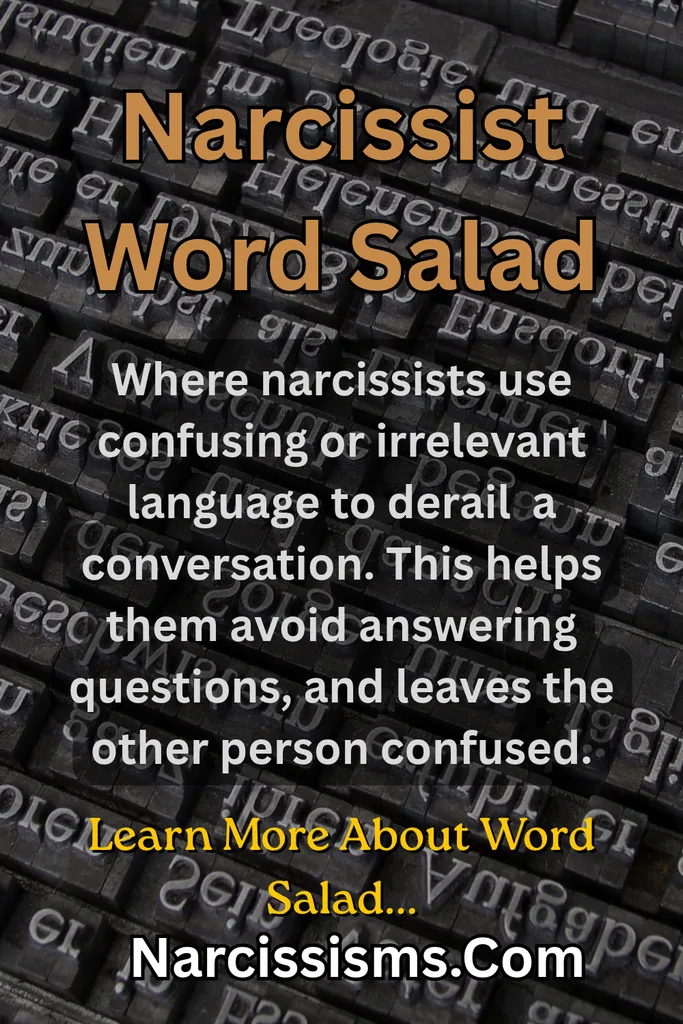
Narcissist word salad is where narcissists use confusing, irrelevant, contradictory, or excessive language to derail conversations and avoid the actual issue.
Rather than answering a straightforward question or acknowledging something they’ve done, they jump between unrelated subjects, twist your words, bring up past disagreements, or launch into long boring explanations that leave you more confused than when you started.
You might ask why they lied, only to end up discussing your supposed lack of trust. The original issue disappearing under a mountain of unrelated arguments.
Why Do Narcissists Use Word Salad?
There’s several reasons why narcissists use word salad. The common thread is the conversation becomes less about resolving an issue and more about avoiding being challenged. Here are some reasons why narcissists use word salad…
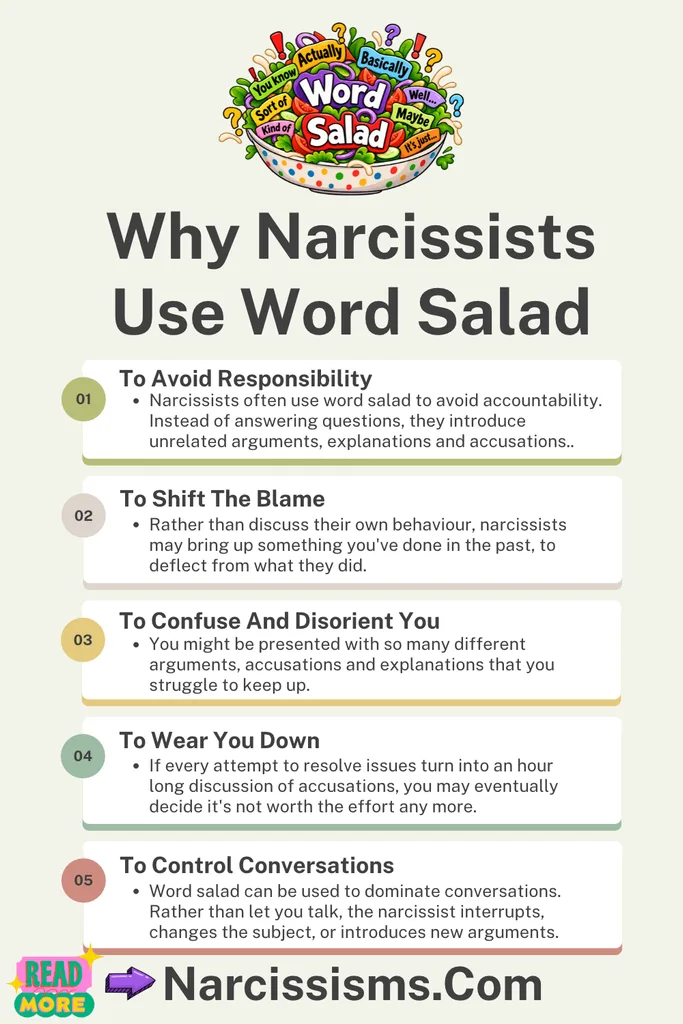
1. To Avoid Responsibility
One of the most obvious uses of word salad is to avoid accountability. Instead of answering your question, they introduce unrelated arguments, explanations and accusations.
For example, you ask why they were flirting with someone, only to be told you’re insecure, jealous, and controlling. Suddenly you’re defending yourself, instead of discussing their behaviour.
2. To Shift The Blame
Word salad can also be used to turn the tables on someone who raises a legitimate concern. Rather than discuss their own behaviour, narcissists may bring up something you’ve done, exaggerate a minor disagreement, or suggest that you’re responsible.
This can leave you feeling like you need to apologise. Even though they wronged you!
3. To Confuse And Disorient You
Sometimes the sheer volume of information is overwhelming. You might be presented with so many different arguments, accusations and explanations that you struggle to keep up.
Just as you address one point, another is introduced. Then another. Ping-ponging you everywhere.
Eventually you struggle to remember what was said, what you originally asked, and which parts of the conversation were relevant.
This confusion makes it harder to challenge their behaviour, or maintain confidence in your understanding of things.
4. To Wear You Down
Endless arguments are draining. If every attempt to resolve issues turn into an hour long discussion of accusations and contradictions, you may eventually decide it’s not worth the effort any more.
So you may stop asking questions, raising concerns, or challenging their behaviour because you know it’s not worth it.
5. To Control Conversations
Word salad can also be used to dominate conversations. Rather than let you to express your concerns, the narcissist continually interrupts, changes the subject, or introduces new arguments. You never get the chance to properly express yourself.
The conversation becomes something you have to navigate, rather than an chance to communicate. This can leave you feeling powerless and unheard.
How Narcissists Stop You Resolving Relationship Problems
Examples Of Narcissist Word Salad
The easiest way to understand narcissist word salad is to look at examples of what it sounds like in everyday conversations.
Here are some illustrative examples rather than exact scripts. The important thing is the pattern of communication and how the original issue gets lost…
The Unanswered Question
You: “Why did you lie about where you were last night?”
Them: “I can’t believe you’re questioning me again. You never trust me. What about when you went out with your friends and didn’t tell me exactly when you’d be home? You’re always looking for something to complain about. If you spent less time worrying about what I’m doing and more time looking at your own behaviour, we’d actually have a decent relationship.”
Notice how the original question never gets answered. Instead, the conversation shifts to an argument about your supposed shortcomings.
The Never Ending Excuse
You: “You promised you’d help me, but you didn’t bother.”
Them: “I was going to, but you never give me any time to do anything. You always expect everything to happen immediately. I had a lot on my mind, and anyway, you said you were going to do something last week and you didn’t. I don’t see you complaining about that.”
Rather than acknowledging they failed to keep a promise, they introduce a series of excuses and counterarguments. Before long, you’re discussing something totally unrelated.
Turning Your Concern Into An Attack
You: “I don’t like the way you speak to me when we’re around other people.”
Them: “So I’m not allowed to talk in public now? You just want someone who agrees with everything you say. You’re always trying to make me look bad. I can’t say anything without you finding something to criticise.”
Your attempt to discuss their behaviour gets bent into accusations that you’re controlling and unreasonable.
Bringing Up The Past
You: “You embarrassed me in front of everyone earlier.”
Them: “Oh, here we go again. What about the time you embarrassed me at that family gathering? And what about when you said that thing to my friend? You have a very selective memory.”
Instead of discussing what happened today, they drag up old disagreements and introduce a completely different argument.
Twisting The Truth
You: “You told me you weren’t speaking to your ex any more.”
Them: “I haven’t spoken to them. I sent them a message. I never said I wouldn’t contact them. You’re always twisting things I say.”
They’re deliberately focusing on the technical meaning of the word ‘speak’ rather than acknowledge the obvious meaning of what you were discussing. This lets them sidestep the original issue, while making you look unreasonable.
The Personal Attack
You: “Why did you spend so much money without discussing it with me?”
Them: “You’re obsessed with money. It’s all you ever think about. I bet you wouldn’t be complaining if I spent it on you.”
Rather than addressing the financial decision, they attack your character and bring up unrelated emotional arguments.
The Victim Routine
You: “I feel like you’re taking me for granted.”
Them: “After all I’ve done for you? I bend over backwards, and all I get is criticism. Perhaps you’d be happier if I just stopped doing anything.”
Your attempt to express how you feel becomes an opportunity to portray themselves as the victim. Then they use this to threaten withdrawing all help.
The Circular Argument
You: “I just want you to acknowledge what you said was hurtful.”
Them: “Well, I wouldn’t have said it if you hadn’t annoyed me. You know how I get when people push me. You need to understand that your behaviour affects me too. If you didn’t keep bringing things up, we wouldn’t be having these arguments.”
You try to bring the conversation back to the original point, but you keep ending up in the same place. Nothing is resolved, and you’re left feeling like you’re going round in circles.
How Does Narcissist Word Salad Affect You?
One of the biggest problems is that you may gradually lose confidence in your ability to communicate. You might find yourself…
- Replaying conversations in your head, trying to work out what actually happened.
- Questioning whether you misunderstood something.
- Feeling guilty for raising reasonable concerns.
- Feeling anxious about bringing up difficult subjects.
- Spending hours trying to explain yourself.
- Feeling mentally exhausted after even the simplest disagreements.
- Apologising to bring arguments to an end. Even though you didn’t do anything wrong.
- Avoiding conversations because you know they’ll go nowhere.
You might start preparing what you’re going to say in advance, carefully choosing your words and anticipating every possible response. Which is an exhausting way to live.
Healthy communication should let two people express themselves, listen to each other, and work out an understanding. It shouldn’t require one person to spend hours defending their right to ask questions or have an opinion.
How To Respond To Narcissist Word Salad
One of the most important things to understand about word salad is that you don’t have to join in every argument you’re invited to.
If someone repeatedly turns straightforward conversations into confusing, circular debates, trying harder to explain yourself may not solve the problem. Here are some ways to protect your emotional well being…
1. Keep Bringing The Conversation Back To The Point
This is a biggie – stay calm and keep this in mind, and it makes a huge difference. If the conversation drifts to unrelated subjects, (which it inevitably will!) calmly return to your original point.
When someone is determined to avoid accountability, they may do everything they can to steer the conversation away from the original issue. So keep your original point in mind, and keep returning to it. You may notice that the better journalists do this when interviewing politicians!
2. Stop Defending Yourself Against Every Accusation
One of the easiest ways to get trapped in word salad is to feel compelled to defend yourself against everything the narcissist says.
They might make five different accusations, each requiring a lengthy explanation. Before you know it, you’re no longer discussing the original issue.
You don’t have to answer every accusation, particularly when they’re being used to derail the conversation.
3. Avoid Getting Drawn Into Circular Arguments
If you find yourself repeating the same points without making progress, recognise that the conversation may not be productive. You could say…
“We’re going round in circles, and I’m not going to keep repeating myself.”
Sometimes, it’s not that they don’t understand your point. It’s that they’re unwilling to acknowledge it. Continually explaining yourself can leave you confused and emotionally exhausted.
4. Don’t Feel Obliged To Have The Last Word
It’s tempting to keep arguing until they admit they’re wrong. But if they’re unwilling to engage honestly, then you’ll probably never get that acknowledgement.
You don’t need their agreement to know that your concerns are legitimate. Walking away from unproductive arguments can help you reclaim your peace of mind.
5. Keep A Record Of Important Conversations
If someone regularly contradicts themselves, denies previous statements, or changes their version of events, keep a private record of incidents to help you maintain perspective.
This is particularly useful when dealing with practical matters such as money, responsibilities, agreements or arrangements. Written communication can also reduce opportunities for conversations to become muddled or misrepresented.
6. Establish Boundaries
You have every right to decide what kind of communication you’re prepared to accept. You might explain that you’re willing to discuss disagreements, but not willing to participate in conversations with personal attacks.
A boundary isn’t about forcing someone to behave differently. It’s about deciding what you’ll do if the behaviour continues.
How To Set Boundaries For Narcissists
3 thoughts on “Narcissist Word Salad: How They Confuse You To Avoid Accountability”