
Have you found yourself feeling guilty for saying no to a narcissist? Perhaps you’ve tried to establish a boundary, spend some time for yourself, or disagree with them. Only to be made to feel selfish and uncaring. If so, you may have experienced narcissist guilt tripping.
Guilt tripping is a manipulation tactic that involves making someone feel guilty, responsible or ashamed. This creates emotional pressure to make you feel like you’ve no choice but to cave in to their demands.
In this article, I’ll explore how narcissists use guilt to manipulate others, some common guilt tripping phrases to look out for, and how to protect yourself from this narcissist guilt tripping…
Please CLICK HERE if you want to jump to examples of 13 guilt tripping phrases
Why Do Narcissists Use Guilt Tripping?
Guilt is a powerful emotion. Most people don’t like feeling that they’ve hurt someone, or behaved selfishly. So some narcissists exploit this desire to be kind and considerate.
Rather than respecting your decisions, they may try to make you feel bad about them. The objective is to get you to change your mind, comply with their demands, or take responsibility for their feelings.
There are several reasons why narcissists use guilt tripping…
To maintain control
Narcissist relationships often involve an imbalance of power. The narcissist usually expects their needs and preferences to take priority.
Guilt tripping helps maintain this imbalance. If you feel guilty when you stand up for yourself, then you may eventually stop challenging their behaviour altogether.
To avoid taking responsibility
Narcissist often struggle acknowledging their mistakes, or accepting criticism. Instead of addressing something they’ve done wrong, they might turn the situation around to make you feel guilty for bringing it up.
Suddenly, you’re the one apologising. While the original issue remains unresolved.
To make you prioritise their needs
You might want to spend time with friends, pursue a hobby, or have time to yourself. However, the narcissist may respond like your decision is a rejection.
By making you feel guilty, they can encourage you to abandon your needs in favour of theirs. Because most people don’t want to appear to be rejecting them when they actually just want time for themselves.
To exploit your empathy
People who are compassionate often find it difficult to see somebody upset. So narcissists use this to their advantage.
They may present themselves as hurt, abandoned, or mistreated when you don’t do what they want. So you end up feeling responsible for making them happy. Even when you’ve done nothing wrong. This is essentially weaponising your empathy…
How Narcissists Weaponise Your Empathy
13 Examples Of Narcissist Guilt Tripping Phrases
One of the easiest ways to recognise guilt tripping is to familiar yourself with the language used. Here are 13 examples of phrases a narcissist might use to make you feel guilty…
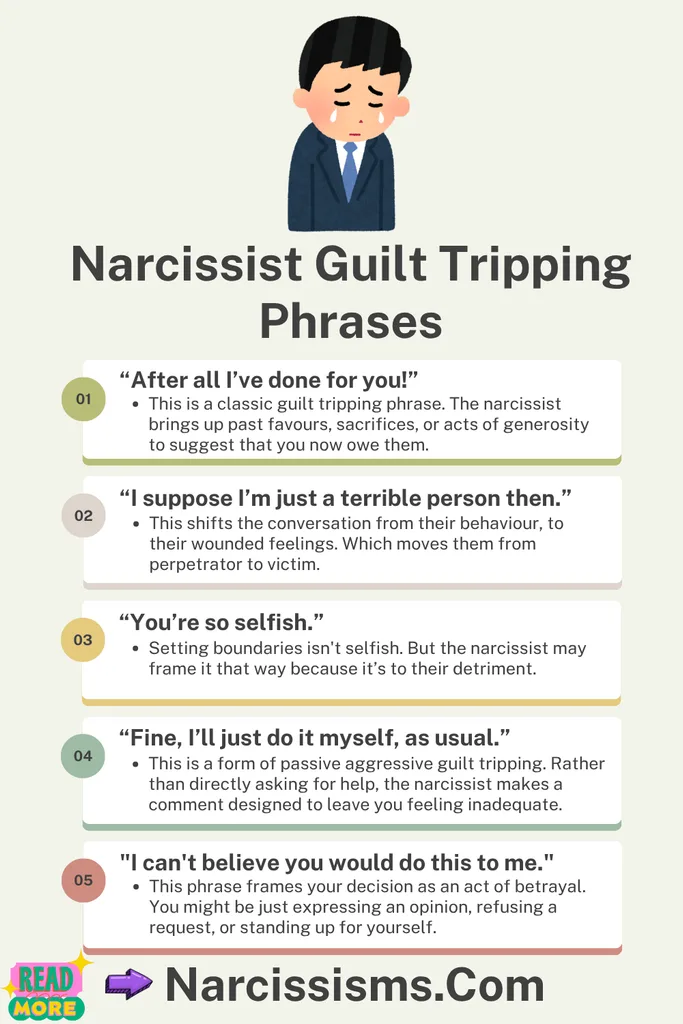
1. “After all I’ve done for you!”
This is a classic guilt tripping phrase. The narcissist brings up past favours, sacrifices, or acts of generosity to suggest that you now owe them.
It doesn’t matter whether those things were freely given. They are now being presented as a debt you must repay.
2. “I suppose I’m just a terrible person then.”
Rather than discussing the actual issue, the narcissist plays the victim. You may have pointed out something that upset you. Then suddenly you’re reassuring them that they’re not a terrible person.
The conversation shifts from their behaviour, towards their wounded feelings. Which moves them from perpetrator to victim.
3. “You don’t want to see your friends then?”
If you’re friends with a narcissist, then they might expect you to drop everything when they call. No matter how tired or busy you are.
Rather than respect your needs, the narcissist frames it as a rejection. Even though your reasons are perfectly valid.
4. “I wouldn’t treat you like that.”
This is designed to make you question your own behaviour.
The narcissist presents themselves as the more considerate person. Implying that you’ve failed to show them the same level of kindness they supposedly give you.
This can be particularly effective when you’ve already been made to feel guilty about something.
5. “You’re so selfish.”
Setting boundaries isn’t selfish. But a narcissist may frame it that way.
When you start prioritising your own needs, they may accuse you of being inconsiderate, uncaring or self centred.
The aim is to make you feel that it’s wrong to look after yourself. So you prioritise them instead.
6. “I do everything for you, and this is how you repay me?”
This is another variation of keeping score.
The narcissist may remind you of everything they’ve supposedly done for you. Suggesting that your refusal to meet their demands is a betrayal.
Remember – healthy relationships aren’t supposed to operate like a never ending debt repayment scheme.
7. “Fine, I’ll just do it myself, as usual.”
This is a form of passive aggressive guilt tripping. Rather than directly asking for help, the narcissist makes a comment designed to leave you feeling inadequate.
You may end up offering help just to relieve the uncomfortable atmosphere.
8. “You’re making me feel this way.”
This phrase shifts responsibility for their emotions onto you.
Of course, other people’s actions can affect how we feel. However, there’s a difference between explaining that something has upset you, and making someone responsible for managing your emotions.
You cannot be expected to prevent someone from ever feeling disappointed, frustrated, or unhappy.
9. “I guess I’ll have to suffer then.”
Here, the narcissist exaggerates their predicament to make you feel responsible for their discomfort. Perhaps you declined to do something for them. Or refused to change your plans.
Instead of accepting your decision, they present themselves as helpless and abandoned. All because of you.
10. “Your family and friends are more important than me.”
This is an attempt to make you feel guilty for having relationships and interests outside the narcissist relationship. They may resent the time and attention you give to other people.
By suggesting that you’re neglecting them, they can encourage you to stop seeing friends and family. Which isolates you and takes you away from your wider support network.
11. “I can’t believe you would do this to me.”
This phrase frames your decision as an act of betrayal. You might be expressing an opinion, refusing a request, or standing up for yourself.
However, the narcissist presents your behaviour as something deeply hurtful that you deliberately did to them.
12. “You’ll regret treating me this way.”
This combines guilt tripping with intimidation. The narcissist suggests that your decision will have unpleasant consequences. Which can make you feel guilty and anxious for standing your ground.
It can be particularly unsettling when accompanied by threats to withdraw affection, support or contact.
13. “One day, you’ll realise how much I’ve sacrificed for you.”
This is an attempt to make you feel indebted.
The narcissist positions themselves as someone who’s given up so much for your benefit. Implying that you’re ungrateful for not appreciating their efforts.
It can leave you feeling that you owe them your time, attention, and loyalty. No matter what. This attitude is common with narcissist parents.
10 Things Narcissist Parents Say To Avoid Accountability
How Narcissists Use Guilt Tripping In Different Situations
Guilt tripping isn’t always obvious. Sometimes it’s delivered through subtle comments, emotional reactions, or seemingly innocent remarks.
Here are some common situations where guilt tripping can occur…
When You Set Boundaries
Imagine you’ve decided you won’t tolerate a certain behaviour. Perhaps you’ve told a narcissist that you won’t accept being shouted at, or insulted. Rather than respecting your boundary, they might respond…
“So now I’m not even allowed to speak to you?”
Or…
“I can’t do anything right, can I?”
The conversation quickly becomes about how unfairly they’re being treated. Rather than the behaviour that prompted your boundary.
You may find yourself explaining, defending, and even apologising for something that was perfectly reasonable.
15 Things Narcissists Say When You Set Boundaries
When You Spend Time Away From Them
Narcissists can become resentful when you spend time doing things that don’t involve them. You might want to see friends, visit family, or enjoy a weekend away.
They may respond with comments such as…
“Don’t worry about me. I’ll just sit here on my own.”
Please CLICK HERE For How To Say No To A Narcissist
8 thoughts on “Narcissist Guilt Tripping: How Narcissists Use Guilt To Control You”