Empathy is often considered one of our greatest strengths. It’s the ability to understand, connect, and care about others. It’s to share their joy, and feel their pain. And to connect emotionally. But in the wrong hands, empathy can leave you vulnerable.
Narcissists are often good at spotting empathetic people, and subtly turning that empathy into a tool for control. But this isn’t always obvious when you’re on the receiving end. Here’s some of the ways narcissists weaponise your empathy…
Please Watch The Following Short Video To Aid Your Understanding…
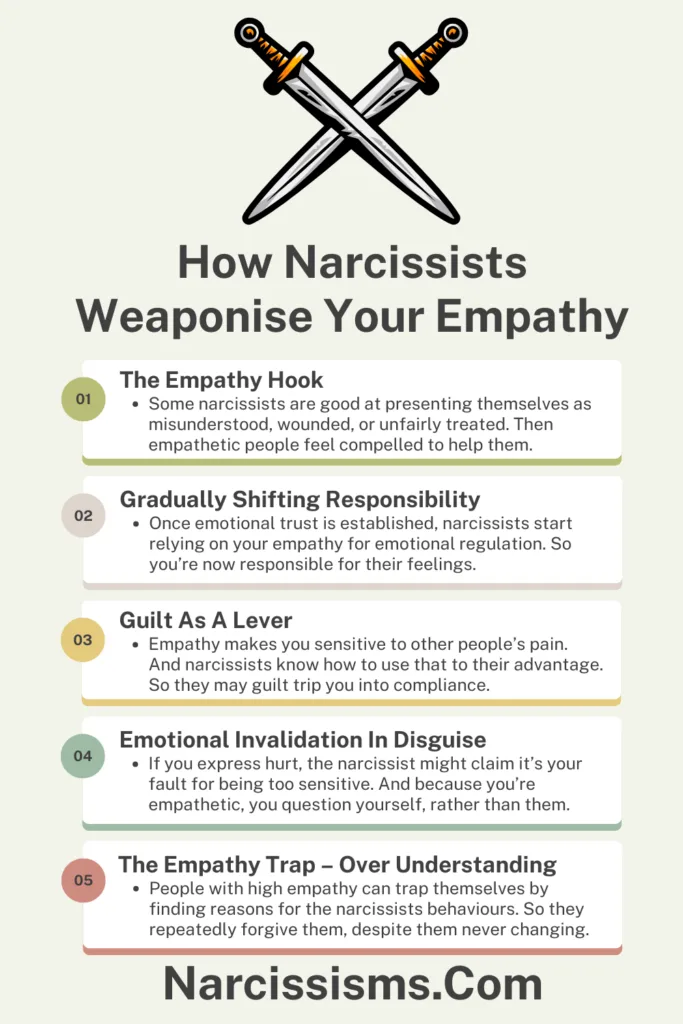
The Empathy Hook
Covert narcissists in particular are good at presenting themselves as misunderstood, wounded, or unfairly treated. Early on, they may share personal stories to gain your sympathy. Such as difficult childhoods, toxic ex-partners, and their ongoing struggles.
For an empathetic person, this creates an immediate emotional investment. You want to help. You want to understand. You may even feel uniquely chosen to support them. After all, it can be quite flattering when someone reaches out for your help.
Real life example…
You started dating someone who opens up about how their past partners “betrayed” them. They describe how they were hurt over and over again.
You feel compassion and think, “I’ll be different. I won’t hurt them like the others did.” From that point on, you’re more tolerant of their behaviour, because you don’t want to add to their pain. Which means they can get away with more.
Gradually Shifting Responsibility
Once emotional trust is established, the dynamic shifts. Narcissists start relying on your empathy not just for support, but for emotional regulation…
- Their bad moods become your problem to solve.
- Their anger becomes something you feel responsible for calming.
- Their insecurities become something you must constantly reassure.
Over time, you may notice that your role has changed from partner, friend, or colleague into something closer to a carer.
Real life example…
Your partner comes home from work angry, and snaps at you. Instead of addressing how they spoke to you, you find yourself trying to cheer them up, cooking their favourite meal, or walking on eggshells so you don’t “set them off” again. So the narcissist was verbally abusive, yet you apologised.
Guilt As A Lever
Empathy makes you sensitive to other people’s pain. And narcissists know how to use that to their advantage.
They may say things like…
- “I can’t believe you’d treat me like this. After everything I’ve been through.”
- “You’re the only person I can rely on.”
- “If you really cared about me, you’d understand.”
These statements aren’t really about communication. They’re about control. They create guilt, and this guilt pressures you to override your own needs for theirs.
Please CLICK HERE For Why People Love Serial Killers
Real life example…
You tell a friend you can’t meet them because you’re exhausted. They respond, “Wow… I guess I don’t matter to you.” So instead of resting, you go.
You feel drained but guilty for even thinking about saying no. But a friend that genuinely cared about you wouldn’t want you to come if you didn’t feel like it.
Emotional Invalidation In Disguise
One of the more confusing tactics is when narcissists flip empathy back to you in a distorted way.
If you express hurt, they might respond with…
- “You’re too sensitive.”
- “You’re overthinking it.”
- “You know I didn’t mean it like that.”
But because you’re empathetic, you question yourself instead of them. You try to see their perspective, even when your own feelings are valid. This doubt is what keeps this dynamic running. Because conscientious people often repeatedly give the benefit of the doubt.
Real life example…
You bring up something that upset you. Maybe they ignored you all evening at a social event. They respond, “You always make a big deal of everything. I was just tired.” You end up apologising for bringing it up, even though your feelings were reasonable.
The Empathy Trap – Over Understanding
Empathetic people often pride themselves on seeing the bigger picture. But narcissists exploit this by encouraging endless understanding without accountability.
You might find yourself thinking…
- “They act this way because of their past.”
- “They don’t mean to hurt me.”
- “They just need more support.”
Although these thoughts come from compassion, they can keep you stuck in unhealthy situations far longer than you should be.
Real life example…
Your partner repeatedly cancels plans last minute or lets you down. Each time, there’s a reason. Stress, family issues, work pressure. You keep forgiving because you understand… but nothing changes.
Why It Works
This dynamic works because empathy naturally prioritises connection over conflict. You want to repair, soothe, and give the benefit of the doubt.
But narcissists prioritise control, validation, and self interest. So when these two personalities meet, empathy is something that is manipulated, rather than reciprocated.
Real life example…
In an argument, you try to calmly talk things through and understand their point of view. But they shift the conversation, and deflect blame. This leaves you focussing on resolving things, whilst they avoid accountability. In the end you apologise, despite doing nothing wrong, because it’s the only way you get a resolution.
Breaking the Pattern
Recognising the pattern is the first step. From there, the shift isn’t about losing your empathy. It’s about adding boundaries to it.
- Empathy doesn’t require self sacrifice.
- Understanding someone doesn’t mean excusing their behaviour.
- Caring about someone doesn’t mean tolerating harm. In fact, tolerating it does them a disservice, because it builds resentment in you.
If you take one thing from this article let it be this… Healthy empathy includes yourself in the equation! Your needs also matter!
Final Thoughts
Having empathy is clearly a good thing. However we often make the mistake of thinking that if something is “good”, then we should do as much of it as possible. The more the merrier. However this doesn’t always work in real life.
If you’re too empathetic, then you’d let a thief break into your home and walk away with your things. Because they must be poor and in need. You could let the local vagabonds take over your home, because they just need somewhere to live. Or you might let a friend repeatedly abuse you because they must have mental health issues.
Healthy empathy is about balance. Good people who appreciate and reciprocate your kindness deserve your empathy. But people who exploit it don’t.
You don’t have to turn into a monster to avoid your empathy being taken advantage of. You can be your nice empathetic self with people you want to be that with. But if someone repeatedly takes advantage, then you have every right to withdraw this.
The goal isn’t to be less caring. It’s to become as committed to your own well being as you are to others’. Because you deserve a nice life too.
Please CLICK HERE For How Toxic Empathy Plays Into Narcissists Hands