Narcissists see boundaries as obstacles to overcome. Rather than guidelines to be respected.
So, many people find themselves trapped in exhausting cycles of conflict, guilt, manipulation, and doubt. They know they need stronger boundaries, but every boundary seems to trigger arguments and emotional backlash.
The good news is that effective boundaries with narcissists are possible. You may not be able to change a narcissist’s behaviour, but you can change how much they can access your time, energy, and emotions.
This guide explains why boundaries are important, why narcissists resist them, and how to establish limits that actually work…
Why Boundaries Are Essential
Healthy thinking people have limits of what they take from others. We have an intuitive balancing system, where we feel compelled to give back if we take. So we limit ourselves to avoid feeling too much “in debt”. But narcissists are different.
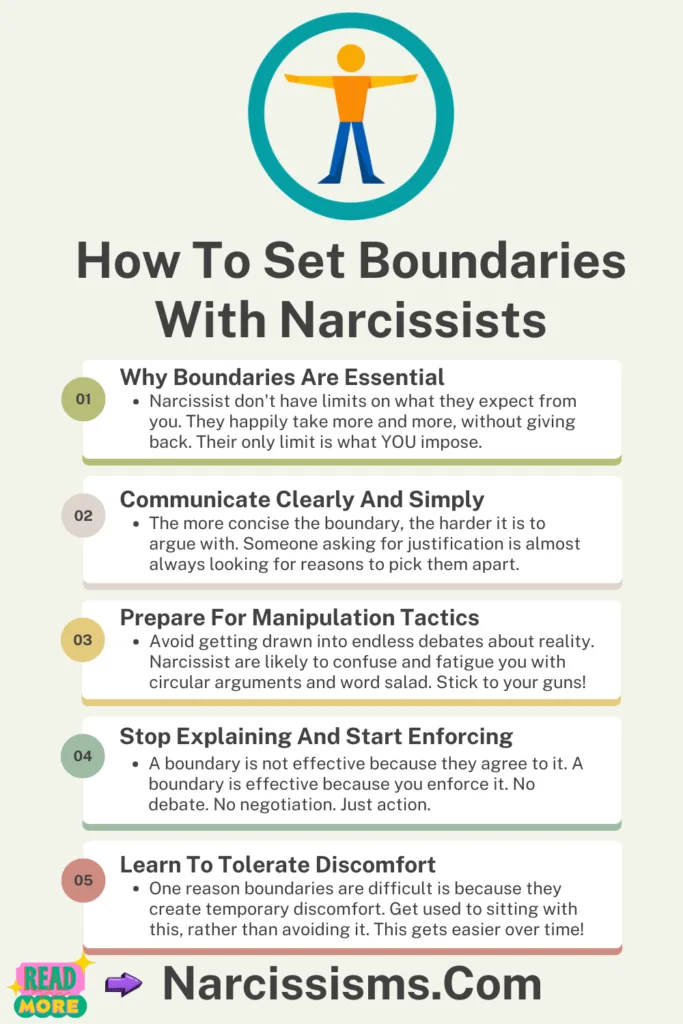
Narcissist don’t have limits on what they expect from you. They happily take more and more, without giving anything back. Their only limit is what YOU impose.
Many people think boundaries are designed to change someone else’s behaviour. In reality, boundaries are designed to protect your well being…
A boundary is a statement of what YOU will do if a certain behaviour occurs. Not what they should do. For example…
- “If you start shouting, I’ll end the conversation.”
- “If you keep insulting me, I’ll leave.”
Notice that both statements focus on your actions, rather than trying to force the narcissist to change. This is crucial because you can’t control a narcissist’s choice. But you can control your response.

Why Narcissists Resist Boundaries
Many people get discouraged when narcissists push back at boundaries. They assume they must be doing something wrong. But resistance is to be expected.
When someone is accustomed to unrestricted access to your time, attention, and emotional energy, boundaries feel threatening to them. They feel they’re losing something they’re entitled to. So the narcissist may react by…
- Arguing with your boundary.
- Questioning your motives.
- Calling you selfish.
- Playing the victim.
- Recruiting others to pressure you.
This reaction doesn’t mean your boundary is unreasonable. It means your boundary is disrupting an arrangement that benefited them.
Signs You Need Stronger Boundaries
Many people normalise unhealthy treatment for years, before realising that boundaries are needed. You may need stronger boundaries if…
- You constantly walk on eggshells.
- You feel responsible for someone else’s emotions.
- Your needs are often dismissed.
- You struggle saying no.
- You feel guilty when you prioritise yourself.
These often indicate that your personal limits are not being respected.

Step 1: Identify What You Need To Protect
Before creating boundaries, identify what’s being affected. Consider the following areas…
Emotional Boundaries
Protect your feelings and mental well being. Examples…
- Refusing verbal abuse.
- Avoiding conversations designed to shame or manipulate.
- Limit emotional care taking.
Time Boundaries
Protect your schedule and availability. Examples…
- Not answering calls late at night.
- Limiting the duration of visits.
- Declining last minute demands.
- Answering when you want to answer.
Physical Boundaries
Protect your personal space and comfort. Examples…
- Asking for privacy.
- Refusing unwanted physical contact.
- Controlling access to your home.
Financial Boundaries
Protect your financial security. Examples…
- Not lending money.
- Refusing financial manipulation.
- Keeping accounts separate.
Narcissists often try to enmesh their finances with yours. Because it gives them opportunities to take. So they may try things like going halves on buying a car, or other expensive items. Or pooling your money and resources together in others ways. Don’t do it!
Step 2: Communicate Clearly And Simply
One of the biggest mistakes people make is over explaining. When dealing with narcissists, detailed explanations become opportunities for debate. Rather than statements to be respected. So instead of saying…
“I’ve been feeling overwhelmed because every time we talk it turns into an argument. I need some space because work has been stressful…”
Try…
“I won’t continue conversations if they’re disrespectful.”
Short. Clear. Direct.
The more concise the boundary, the harder it is to argue with. Remember, healthy boundaries don’t need elaborate justification. Someone asking for justification is almost always looking for reasons to pick them apart.
Please CLICK HERE For 7 Phrases To Disarm Narcissists
Step 3: Prepare For Manipulation Tactics
Many narcissists respond to boundaries with these manipulation tactics…
Guilt Tripping
Examples…
- “After all I’ve done for you.”
- “I can’t believe you’d treat me like this.”
Response…
“I know you’re upset, but my decision stands.”
Gaslighting
Examples…
- “That never happened.”
- “You’re too sensitive.”
Response…
“I remember it differently.”
Avoid getting drawn into endless debates about reality. Narcissist are likely to confuse and fatigue you with circular arguments and word salad. Stick to your guns!
Anger And Intimidation
Examples…
- Shouting.
- Threats.
- Aggressive criticism.
Response…
“This conversation is over.” Then follow through.
You HAVE to follow through, or they’ll NEVER respect this boundary again.
Love Bombing
Sometimes resistance appears positive rather than hostile. A narcissist may suddenly become affectionate, generous, or apologetic to regain influence.
While genuine change is possible, it’s rare with narcissists. They usually go into “nice mode” when they sense they’ve pushed you too far. But revert back to type as soon as they’ve reeled you back in.
Step 4: Stop Explaining And Start Enforcing
Many people spend years trying to convince narcissists that their boundaries are reasonable. This rarely works.
A boundary is not effective because they agree to it. A boundary is effective because you enforce it.
No debate. No negotiation. No repeated warnings. Just action. Because if you don’t, then your boundary is meaningless.
Consistency is what turns a statement into a real boundary. Especially with narcissists.

Step 5: Learn To Tolerate Discomfort
One reason boundaries are difficult is because they create temporary discomfort. You may experience guilt, anxiety, and self doubt.
These emotions don’t mean your boundary is wrong. Many people who grew up with narcissist parents were taught that having needs was selfish. As adults, setting healthy limits can feel unfamiliar, or even frightening.
The goal is not to eliminate discomfort. The goal is to act according to your values, despite the discomfort.
Please CLICK HERE For How To Say No To A Narcissist
Step 6: Reduce Emotional Reactivity
Narcissists often seek emotional reactions, because emotional intensity creates opportunities for control. When possible, keep your responses calm and neutral. Here’s some examples…
- “I hear what you’re saying.”
- “That’s your opinion.”
- “I’m not discussing this any more.”
- “I’ve already decided.”
You don’t need to win every argument. In many situations, refusing to engage is the most powerful response you can give.
The Difference Between Boundaries And Ultimatums
People often confuse boundaries with ultimatums. An ultimatum attempts to force someone to behave differently. A boundary focuses on your own behaviour.
For example…
Ultimatum…
“You have to stop criticising me.”
Boundary…
“If the criticism continues, I will leave the conversation.”
The first tells them what to do. The seconds tells them what YOU will do.
Setting Boundaries With Different Narcissists
Narcissist Parent
You may need to…
- Limit personal disclosures.
- Visit less often, and keep them arms length.
- Refuse to discuss certain topics.
- End conversations when criticism gets too much.
Narcissist Partner
You may need to…
- Protect your financial independence.
- Refuse emotional abuse.
- Seek professional support.
Narcissist Co-worker
You may need to…
- Document interactions.
- Keep emails, texts etc. as evidence.
- Keep communication professional.
- Avoid oversharing personal information.
- Involve management when necessary.
Narcissist Friend
You may need to…
- Limit availability.
- Stop rescuing them from consequences.
- Decline their one sided demands.
- Re-evaluate the friendship if needed.
Different relationships require different strategies, but the underlying principle remains the same… protect your well-being.
When Low Contact Or No Contact Is Needed
In some situations, boundaries may not be enough. If the relationship involves emotional abuse, intimidation, harassment, etc. then stronger measures may be needed.
Low contact may involve…
- Limiting communication.
- Reducing visits.
- Restricting personal information.
No contact may involve…
- Ending the relationship.
- Blocking ALL communication.
- Creating complete distance.
These decisions are personal and should be considered carefully. Especially when family or shared responsibilities are involved.
Please CLICK HERE For The Correct Way To No Contact Narcissists
Frequently Asked Questions
Do narcissists respect boundaries?
Some narcissists eventually learn to respect boundaries when they consistently encounter consequences. Others keep challenging them. The key is understanding that your ability to maintain strong boundaries does not depend on their approval.
Please CLICK HERE For How Narcissists Test Your Boundaries
Why do I feel guilty setting boundaries?
Many people have been conditioned to prioritise other people’s needs above their own. Guilt is often a learned response, rather than evidence that your boundary is wrong.
Should I keep explaining my boundaries?
Generally, no. Repeated explanations usually lead to endless debates. Which gives narcissists wiggle room to renegotiate. State your boundary clearly, and focus on enforcing it consistently. Remember, it’s YOUR boundary.
What if the narcissist gets angry?
Unfortunately anger is a common reaction to boundaries. But their anger doesn’t determine whether your boundary is appropriate. Focus on maintaining your limits calmly and safely.
Can therapy help?
Yes. Therapy can help you identify unhealthy relationship patterns, strengthen self esteem, and develop boundary setting skills.
Is it selfish to set boundaries?
No. Healthy boundaries are a form of self respect and emotional responsibility. They protect your well-being, whilst bringing clarity to relationships. You can actually be a better friend or partner with healthy boundaries. Because you’re less likely to resent them.
Please CLICK HERE For How To Block Narcissists Without Feeling Guilty
Final Thoughts
Setting boundaries with narcissists is not about changing their personality, winning arguments, or getting them to understand. It is about reclaiming ownership of your time, energy, emotions, and choices.
You may face resistance, criticism, guilt, and self-doubt on the way. But every time you uphold a boundary, you reinforce an important truth to yourself. That your needs matter, your feelings matter, and your well-being deserves protection.
You’re no longer abandoning yourself by prioritising others. You’re telling yourself and others that you matter.
Learning to be more assertive helps keep your boundaries strong. Please click the following link for my tips for being more assertive…
Please CLICK HERE For How To Be More Assertive With Narcissists