
In narcissist relationships, flying monkeys are people who act on behalf of the narcissist. They spread the narcissists’ version of events, apply pressure, and help them keep control of other people.
Some flying monkeys knowingly participate in the manipulation. Others have been deceived, and are convinced they’re helping.
Understanding narcissists’ flying monkeys helps you recognise what’s happening, protect your boundaries, and avoid getting caught up in people’s attempts to influence you…
Please Watch the Following Short Video To Aid Your Understanding…
What Are Flying Monkeys In Narcissistic Relationships?
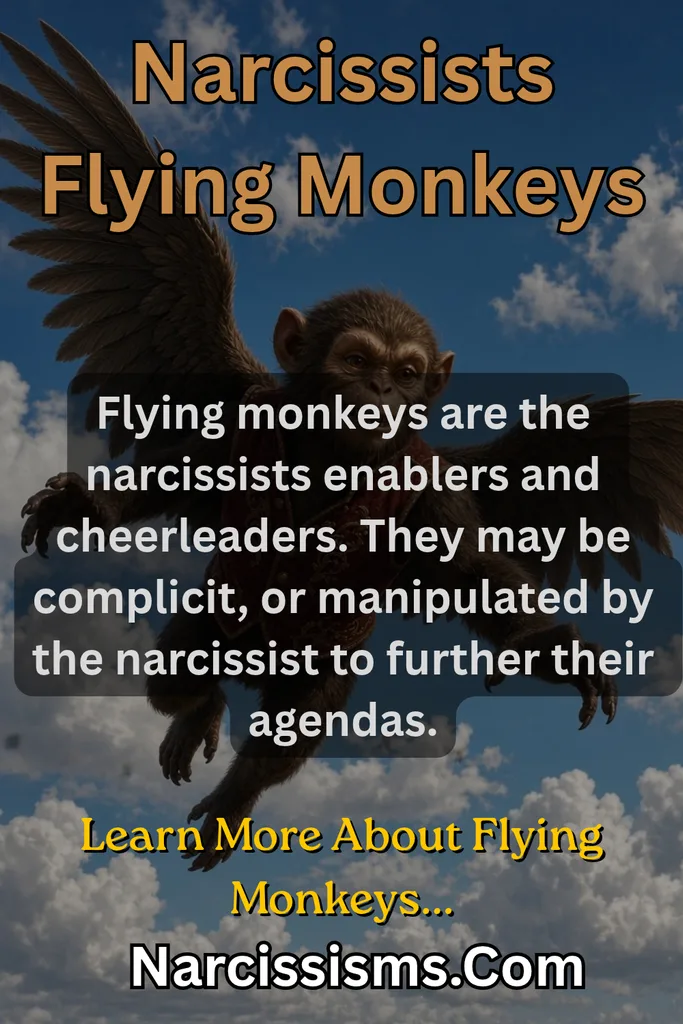
Flying monkeys are people who support, defend, or act on behalf of a narcissist. Often in ways that pressure the narcissist’s target.
They might be friends, family, colleagues, or even people you barely know. The important thing isn’t their relationship with the narcissist. It’s the role they play.
For example, imagine you’ve ended a relationship because your partner repeatedly lied to you. After the split, you might receive messages from mutual friends telling you that you’re being cruel. A relative might insist you should forgive your ex. Someone else might contact you to explain how upset the narcissist is.
If these people repeat the narcissist’s accusations, pressure you to abandon your boundaries, or help the narcissist regain access to you, then they may be acting as flying monkeys.
Why Do Narcissists Use Flying Monkeys?
Most narcissists find it difficult to accept rejection, criticism, or loss of control over a relationship. Involving other people helps them manage how others perceive the situation. Plus they can help them maintain influence over someone who’s trying to break free.
There’s several reasons why narcissists use flying monkeys…
To Protect Their Reputation
Narcissists are often very invested in how other people see them. They might want to maintain an image of being kind, generous, or successful.
If someone challenges this image, then they may discredit them before people question their behaviour.
For example, after a relationship breaks down, the narcissist might tell friends that their ex is unstable, selfish or impossible to please. If those friends accept the story without hearing the other side, then they may defend the narcissist.
To Pressure You Into Giving In
Sometimes, a narcissist might struggle to get the response they want from you. You may have stopped answering their messages, refused to lend them money, or made it clear that you no longer want contact.
So they ask relatives or mutual friends to intervene. These people may tell you that you’re being cruel, that the narcissist deserves another chance, or that you should put the past behind you.
The pressure can become exhausting, particularly when it comes from people you care about. So you may start to question your decision, since so many people seem to disagree with you.
To Gather Information About You
Some flying monkeys act as messengers between you and the narcissist, passing on information about your life.
They might ask whether you’re dating someone new. How you’re coping with separation. Or whether you’ve started seeing friends the narcissist doesn’t like.
Information about your plans, relationships and emotional state can give the narcissist opportunities to contact you, provoke a reaction, or interfere with your decisions. So it’s unlikely to be in your best interests.
To Make You Question Yourself
When several people repeat the same accusations, it can be easy to wonder whether they might have a point.
You may be told you’re selfish, over sensitive, or responsible for the relationship breakdown. Even by people who weren’t present.
This can undermine your confidence. Particularly if you’ve already experienced gaslighting or persistent criticism.
To Punish You For Setting Boundaries
A narcissist may become angry or resentful when you stop accommodating their demands. If they can’t persuade you directly, they may seek support from others to pressure you on their behalf.
For example, you might refuse to attend a family gathering where someone has repeatedly mistreated you. A relative may then contact you to say you’re causing problems, so you need to stop being difficult.
Remember, setting a reasonable boundary isn’t automatically selfish or cruel. Even when it inconveniences other people, or they don’t like it.
15 Things Narcissists Say When You Set Boundaries
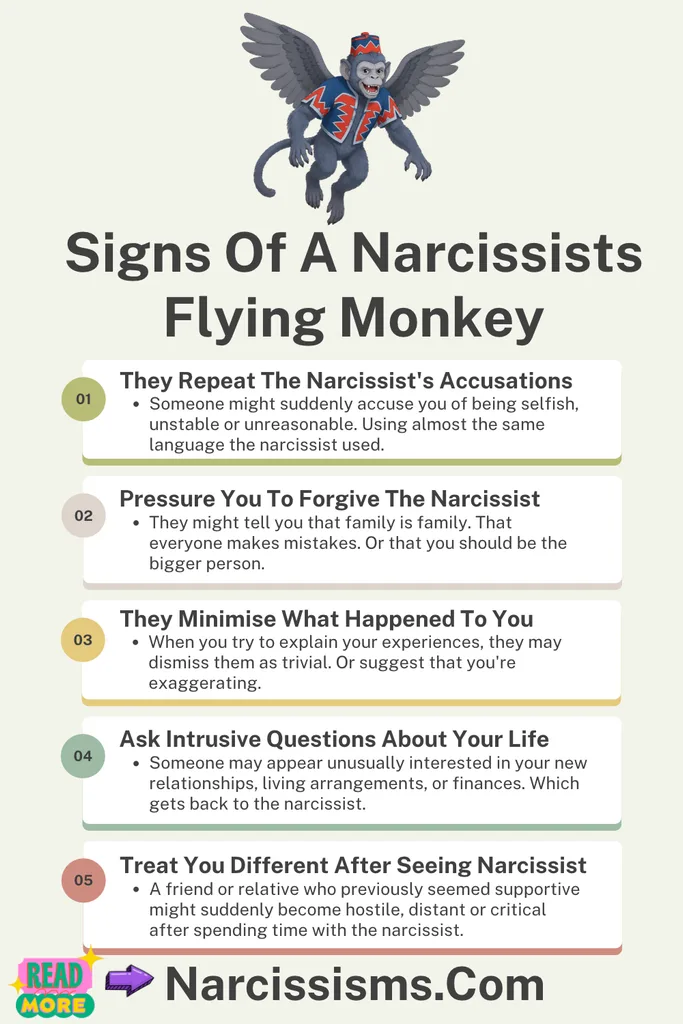
7 Signs Someone May Be Acting As A Flying Monkey
Not everyone who supports a narcissist is deliberately helping them manipulate you. However, these repeated behaviours can suggest that someone is being used to apply pressure, or interfere with your boundaries…
1. They Repeat The Narcissist’s Accusations
Someone might suddenly accuse you of being selfish, unstable or unreasonable. Using almost the same language the narcissist used.
They may have only heard one side of the story and accepted it as fact. Rather than asking what happened first.
2. They Pressure You To Forgive The Narcissist
They might tell you that family is family. That everyone makes mistakes. Or that you should be the bigger person.
Although forgiveness can be valuable, nobody is entitled to demand it from you. Nor does forgiveness require you to let someone back into your life. Especially if they’re harmful.
What Jesus Actually Said About Forgiveness
3. They Minimise What Happened To You
When you try to explain your experiences, they may dismiss them as trivial. Or suggest that you’re exaggerating.
They might say, “That’s just how they are,” or, “You know what they’re like, why let it bother you?” This can leave you feeling like your experience doesn’t matter.
4. They Carry Messages Between You And The Narcissist
They may repeatedly tell you what the narcissist is thinking, how upset they are, or how much they want to speak to you.
They might also pass your responses back to the narcissist. If you’ve chosen to limit contact, this can undermine the distance you’re trying to create.
5. They Ask Intrusive Questions About Your Life
Someone may appear unusually interested in your new relationships, living arrangements, or finances.
There may be nothing suspicious about a single question. But if private details keep finding their way back to the narcissist, then it may be wise to be more selective about what you disclose.
6. They Treat You Differently After Speaking To The Narcissist
A friend or relative who previously seemed supportive might suddenly become hostile, distant or critical after spending time with the narcissist.
This doesn’t prove they’ve been manipulated. But it may be worth considering whether they’ve heard a one sided story.
7. They Refuse To Respect Your Boundaries
Perhaps you’ve explained that you don’t want messages passed between you and the narcissist. But they keep doing it.
You may have asked them not to discuss your private life with the narcissist. Yet they keep sharing information.
Whatever their intentions, repeatedly ignoring clearly communicated boundaries makes it necessary to limit what you share with them. And that’s on them, not you.
Are Flying Monkeys Always Manipulative?
No. This is an important distinction…
Some people knowingly help narcissists spread rumours, apply pressure, or interfere with someone’s life. Others genuinely believe they’re helping, because they’ve been given a misleading account of events.
Narcissists may present themselves as the victim. Which can leave friends and family convinced they’re supporting someone who’s been unfairly treated.
Some people also hate conflict. So they side with whoever tells the most convincing story. Others want to preserve family relationships, or avoid upsetting someone. These people can still cause harm, even if they don’t intend to.
Rather than deciding whether everyone is a narcissist or a flying monkey, focus on what they actually do. Do they respect your boundaries? Are they willing to listen? Do they keep pressuring you after you’ve asked them to stop?
Their behaviour tells you more than any label.
What Is the Difference Between Flying Monkeys And Enablers?
The terms flying monkeys and enablers are sometimes used interchangeably. But there’s a useful distinction.
An enabler is someone whose behaviour lets someone else’s harmful behaviour continue. Perhaps by making excuses for it, covering up the consequences, or repeatedly rescuing them from accountability.
A flying monkey is generally someone who actively supports or acts on behalf of the person. For example by spreading accusations, delivering messages, or pressuring their target.
The same person can fulfil both roles. For instance, a family member who constantly excuses a narcissist’s behaviour may be an enabler. If that family member also contacts the narcissist’s former partner to demand they return, then they may also be acting as a flying monkey.
How To Deal With Narcissists’ Flying Monkeys
Discovering that other people are participating in the conflict can be upsetting. You might feel betrayed, having to defend yourself.
Fortunately, you don’t have to persuade everyone to agree with you to protect your well being…
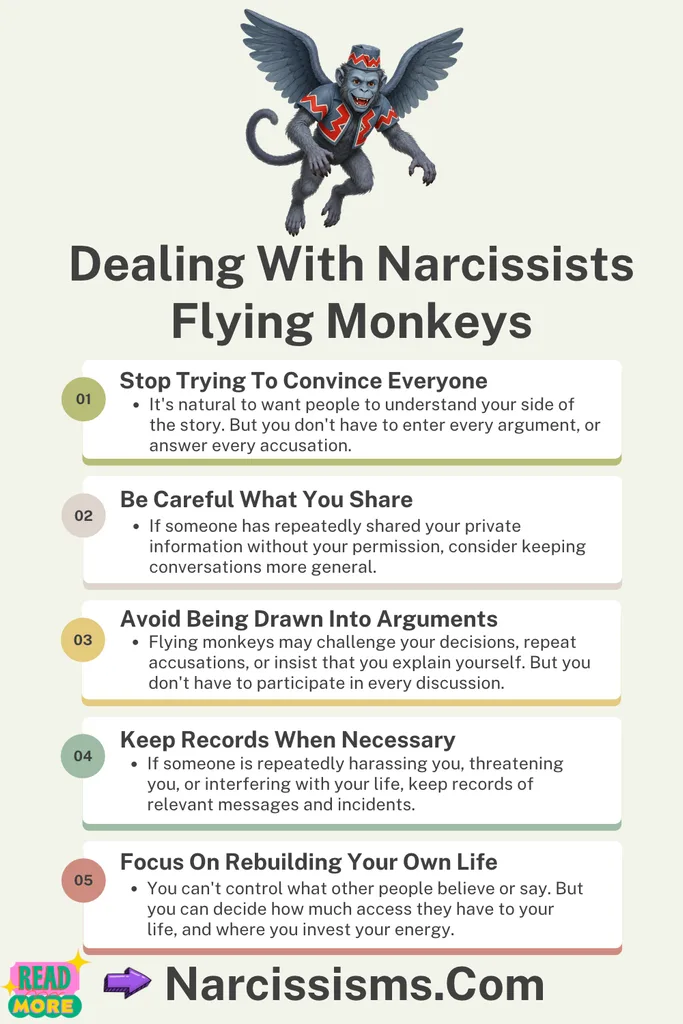
Stop Trying To Convince Everyone
It’s natural to want people to understand your side of the story. Especially if you believe they’ve been told things that aren’t true. However, repeatedly explaining yourself can become draining when someone has already decided what to believe.
You can correct important misinformation when appropriate. But you don’t have to enter every argument, or answer every accusation. Sometimes, a simple statement is enough…
“I understand that you have your own opinion, but I don’t wish to discuss my relationship with you.”
Set Clear Boundaries
If someone repeatedly passes messages between you and the narcissist, tell them that you don’t want them to.
If they respect your request, then you may be able to maintain a relationship with them. If they continue to ignore it, then you may need to reduce contact, or stop sharing personal information.
Remember, a boundary is about what YOU will do. It’s not about forcing someone else to behave differently.
Please CLICK HERE For More Tips For Maintaining Boundaries
Be Careful What You Share
You don’t have to tell everyone about your relationships, plans, or personal circumstances.
If someone has repeatedly shared your private information without your permission, consider keeping conversations more general.
You can remain polite without sharing details that you would prefer to keep private.
Avoid Being Drawn Into Arguments
Flying monkeys may challenge your decisions, repeat accusations, or insist that you explain yourself.
You might feel tempted to prove them wrong. Especially when they make claims that seem completely unfair. But you don’t have to participate in every discussion.
Short responses such as “I’m not discussing this,” or “I’ve made my decision,” can help you avoid getting caught up in circular arguments. If a conversation becomes hostile, you can end it.
Keep Records When Necessary
If someone is repeatedly harassing you, threatening you, or interfering with your life, keep records of relevant messages and incidents. Save messages and note dates where appropriate.
This helps you establish what has happened if you need support from a professional, workplace representative, or legal adviser.
Don’t Assume Everyone Is Against You
When you’ve experienced prolonged conflict, it can be easy to be suspicious of everyone connected to the narcissist. However, not everyone who speaks to them are necessarily involved in a campaign against you.
Some people may genuinely care about you, but have little understanding of the situation. Others may be willing to listen once they realise they’ve only heard one side of the story.
Give people the chance to demonstrate whether they can respect your boundaries, while remaining mindful of repeated patterns that cause harm.
You don’t have to automatically trust everyone. But you don’t need to treat everyone as an enemy either.
Focus On Rebuilding Your Own Life
One of the most draining aspects of a narcissist relationship is the amount of time and energy it can consume.
You may spend hours wondering what the narcissist is saying about you. Who believes them. And whether people are discussing your private life.
Whilst these concerns are understandable, constantly monitoring the situation keeps you emotionally tied to the conflict. Where possible, redirect your attention to your own goals, friendships, interests, and recovery.
You can’t control what other people believe or say. But you can decide how much access they have to your life, and where you invest your energy.
What If The Flying Monkeys Are Your Own Family?
This can be particularly painful because family relationships carry years of shared history, loyalty, and emotional attachment.
You might face pressure to attend family gatherings, reconcile with a relative, or keep the peace for everyone’s sake. In these circumstances, try to separate your relatives’ wishes from your own needs.
You can care about your family without agreeing with them. You can attend some events and decline others. You can maintain contact with certain relatives, while limiting contact with those who repeatedly disrespect you.
If you choose to explain your position, keep it as clear and factual as you can. You don’t have to disclose every painful detail to justify protecting yourself.
If family members continue to pressure or mistreat you, it’s reasonable to question how much contact is healthy for you.
Can You Get Flying Monkeys To See The Truth?
Sometimes you can. But not always.
People who’ve been given misleading accounts may eventually notice inconsistencies. Or witness behaviours that change their understanding of things.
Others may remain convinced by the narcissist’s version of events. Even when you offer a different perspective.
Trying to force someone to recognise the truth can be exhausting and frustrating. Rather than making it your mission to change everyone’s mind, focus on maintaining appropriate boundaries, and building relationships with people who treat you fairly.
You don’t need universal approval to make decisions about your life. If someone genuinely wants to understand your perspective, you can explain it calmly. If they just want to argue, then you’re free to walk away.
Please CLICK HERE For How To No Contact A Narcissist
7 thoughts on “Narcissists Flying Monkeys: Who Are They And How Do They Help Narcissists?”