
Have you ever wondered why you feel exhausted after dealing with a narcissist? You might feel like you’ve run a marathon, even though you’ve done nothing physically demanding.
Living with someone who constantly criticises, manipulates, and creates conflict, is mentally and emotionally draining. This prolonged stress can affect your sleep, concentration, mood, and physical well being.
Why do narcissists leave people feeling so depleted? And why can that exhaustion continue after the relationship has ended? Here’s why…
Please Watch The Following Short Video To Help Your Understanding…
You’re Constantly Walking On Eggshells
One of the most exhausting parts of narcissist relationships is not knowing what to expect. One minute the narcissist seems pleasant and affectionate. The next, they’re criticising you, giving you the silent treatment, or accusing you of something you haven’t even done.
You may find yourself constantly monitoring their mood, analysing their expressions, and carefully choosing your words to avoid provoking them. This can create a state of heightened alertness known as hypervigilance.
This is where your attention is continually directed to predicting potential problems. So instead of relaxing and getting on with life, you use excessive mental energy to anticipate the next argument, criticism, or emotional outburst.
Narcissistic Abuse Keeps You Under Stress
Stress isn’t always bad. In short bursts it keeps us on our toes, and helps us respond to challenges and danger. The problem is when stress is a part of your everyday life.
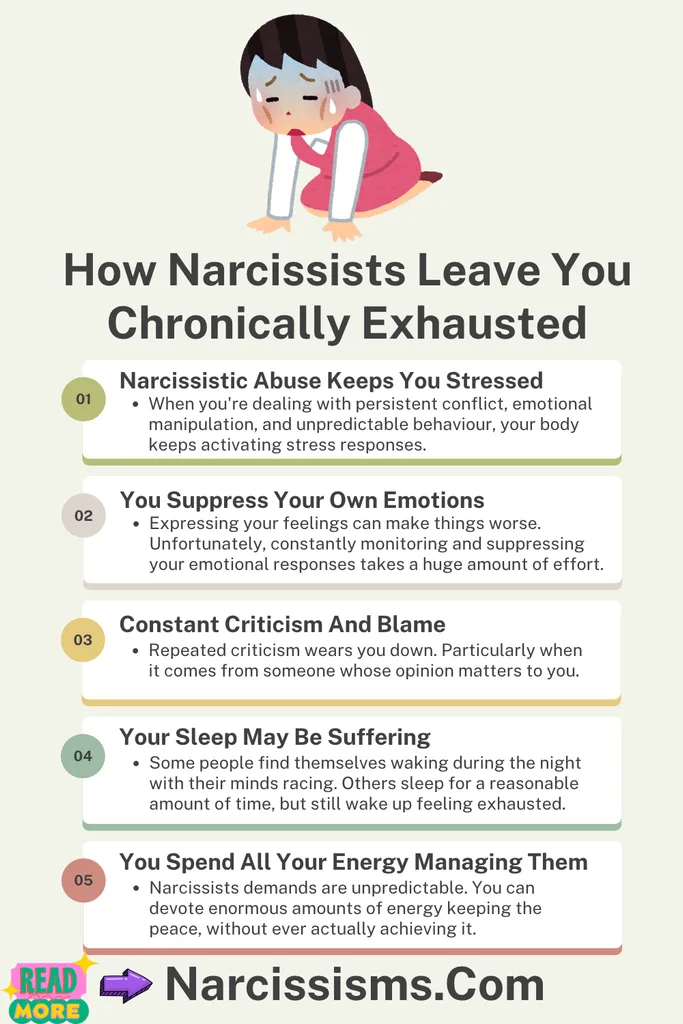
When you’re dealing with persistent conflict, emotional manipulation, and unpredictable behaviour, your body keeps activating stress responses. Over time, these repeated demands can affect your sleep, concentration, mood and energy.
You may find that you have less patience, get overwhelmed more easily, or struggle to cope with situations that previously wouldn’t have bothered you.
Please CLICK HERE For How I Got Out Of Fight Or Flight Mode
Gaslighting Makes You Question Your Reality
Gaslighting can be particularly exhausting because it undermines confidence in your judgement. Perhaps the narcissist says something hurtful, then later insists it never happened. Or they accuse you of being over sensitive when you explain how their behaviour affected you.
As a result, you may find yourself repeatedly reviewing conversations, trying to establish what really happened…
Did I misunderstand them? Was I being unreasonable? Am I remembering things right?
Instead of trusting your own perceptions, you look for evidence to support or disprove your recollections. Which can become a relentless mental exercise.
You might replay conversations while driving. Lie awake analysing arguments. Or spend hours discussing things with friends, hoping to make sense of things.
All this second guessing consumes mental energy. And can leave you feeling confused, anxious, and struggling to concentrate in other areas of your life.
You Constantly Try To Solve Unsolvable Problems
When someone treats you badly, it’s natural to try to understand why. You might examine their behaviour, consider what you could have done differently, and search for ways to improve the relationship.
You might think that if you communicate more clearly, or become more understanding, things will improve. Unfortunately, narcissists refuse to take responsibility for their behaviour. So these efforts may achieve very little.
You may feel compelled to keep trying, because you desperately want the relationship to work. But constantly trying to solve problems that depend on their willingness to change leaves you mentally depleted. Because essentially you’re chasing rainbows.
You Suppress Your Own Emotions
When you’re in a narcissist relationship, expressing your feelings can make things worse.
If you tell them they’ve hurt you, they might become defensive, dismiss your concerns, or accuse you of attacking them. If you express anger, they may use it as evidence that you’re the unreasonable one.
Eventually, you learn to keep your feelings to yourself. You swallow your frustration, hide your disappointment, and pretend everything’s fine.
Even when you’re deeply unhappy. You might convince yourself that your feelings don’t matter as much as keeping the peace.
Unfortunately, constantly monitoring and suppressing your emotional responses takes a huge amount of effort. You may be smiling on the outside while feeling anxious, resentful or miserable inside. And because you can’t express your feelings, the emotional tension may never fully resolve.
Constant Criticism And Blame
Repeated criticism wears you down. Particularly when it comes from someone whose opinion matters to you.
Narcissists might criticise your appearance, abilities, your decisions, and even how you do everyday things. This can lead to you becoming increasingly self conscious, and worrying about making the tiniest of mistakes.
So you spend extra time checking work, explaining decisions, or trying to prove you’ve done nothing wrong. Which creates even more mental strain.
Over time, you can lose confidence in your abilities and feel like nothing you do is good enough. The emotional effort to defending yourself, recover from criticism, and maintaining your self esteem can leave you feeling exhausted.
Your Sleep May Be Suffering
As I’m sure you know, sleep is important for your body and mind to recover from the demands of life. Unfortunately, narcissistic abuse can interfere with your sleep.
You might lie awake at night thinking about earlier arguments. Worry what the narcissist will do tomorrow. Or replay something they said that left you feeling humiliated.
Some people find themselves waking during the night with their minds racing. Others sleep for a reasonable amount of time, but still wake up feeling exhausted.
Stress and anxiety can make it harder to fall asleep or stay asleep. And when sleep is disrupted, fatigue is even more difficult to manage.
This creates a vicious cycle. The more exhausted you are, the harder it is to cope with stress. And the harder it is to cope with stress, the more difficult it is to sleep.
You Spend All Your Energy Managing The Narcissist
In healthy relationships, both people should have room for their own needs, interests, and emotions. But in narcissist relationships, you usually find that most of your time revolves around them.
You might spend your day worrying about their mood, organising your activities around their preferences, or trying to prevent situations that could make them angry.
The difficulty is that their demands are unpredictable, and impossible to meet consistently. You can devote enormous amounts of energy to keeping the peace without ever actually achieving it.
Meanwhile, the things that normally replenish your energy — spending time with friends, exercising, pursuing interests, and enjoying moments of relaxation — all fall by the wayside.
You May Experience Emotional Burnout
When you’re exposed to prolonged stress, you may feel emotionally burned out. You might notice that activities you previously enjoyed no longer appeal to you. You may become emotionally detached, irritable, or unusually sensitive to stress.
Alternatively, you might feel like you’ve run out of emotions. So you no longer have the energy to care about things that used to matter to you.
It’s important to recognise that these experiences aren’t proof of weakness or personal failure. They’re signs that you’re struggling to cope with sustained emotional demands.
You Still Feel Exhausted After Leaving The Narcissist
You might assume that once you leave the narcissist, your energy will quickly return. But unfortunately its not always the case.
Even when free from the narcissist, you may still be processing what happened. You might replay conversations, question your decisions, and wonder how someone you loved could treat you so badly.
You may also be dealing with practical consequences, such as financial difficulties, housing problems, or disagreements about children.
Recovery also takes energy in its own right. Rebuilding your confidence, establishing boundaries, reconnecting with friends and rediscovering your interests all take time and effort.
How To Recover Your Energy After Narcissistic Abuse
If narcissistic abuse left you exhausted, the goal isn’t to push yourself harder. It’s to understand what’s draining your energy. Then give yourself the chance to recover. Here are some steps to help you…
Reduce Your Exposure To Stress Where Possible
If you’re still dealing with the narcissist, consider whether you can reduce unnecessary contact. Depending on your circumstances, this might mean establishing firmer boundaries, limiting conversations to practical matters (grey rock method), or avoiding arguments that go round in circles.
If you don’t have to deal with the narcissist, then it might be better to go completely no contact. It may feel cruel, but you need to make yourself a priority. It’s not like the narcissist didn’t!
Please CLICK HERE For The Right Way To No Contact Narcissists
Stop Trying To Make The Narcissist Understand
It’s natural to want someone to acknowledge what they’ve done. You might believe that if you explain things clearly, they’ll understand your perspective and change their behaviour.
This rarely works with narcissists. They probably knew what they were doing anyway. Especially if they’re fairly high functioning. And even if they didn’t, they’re unlikely to want to change anyway.
Instead they’re more likely to play on your desire for them to change. So they may dangle the carrot and pretend to make some changes. Drawing you back in. Before retreating back to type.
Prioritise Rest And Sleep
Try to maintain a fairly consistent sleep schedule. Create a relaxing bedtime routine, and give yourself time to unwind before going to bed.
If your mind races at night, write down your worries, or make a note of things you want to address the next day. This helps you put them aside for a while. This is something I’ve personally struggled with. Check out the following link for how I improved my sleep…
Please CLICK HERE For How To Improve Your Sleep
Reconnect With Activities That Make You Feel Like Yourself
Narcissistic abuse can gradually narrow your world until your attention revolves around the relationship. Rebuilding your own life helps restore your sense of identity and independence.
Reconnect with old hobbies, interests, and friends, if they still appeal to you. And look for new ones.
Rebuild Your Confidence
Constant criticism, blame and manipulation can undermine confidence in your own judgement. As you recover, practise paying attention to your preferences, feelings, and needs.
Notice when you agree to something you don’t want to do, dismiss your own discomfort, or automatically assume that someone’s feelings are your responsibility.
Over time, these steps help you develop a stronger sense of independence. Plus they reduce the mental effort of constantly second guessing yourself.
Please CLICK HERE For How To Boost Your Confidence
Seek Support When You Need It
You don’t have to recover from narcissistic abuse on your own. Talk to a trusted friend, counsellor, or therapist to help you make sense of your experiences.
Support can be especially valuable if you’re struggling with anxiety, low mood, sleep difficulties, or symptoms associated with trauma. And remember that ongoing fatigue deserves medical attention in its own right.
Persistent exhaustion can have many causes, including anaemia, thyroid problems, sleep disorders, and medication effects. If it continues despite rest, or interferes with your daily activities, then arrange an appointment with a medical professional.
Please CLICK HERE For My FREE Narcissistic Abuse Recovery Roadmap
7 thoughts on “How Narcissists Leave You Chronically Exhausted”